

Beyond the Shelf Life: How Extreme Environments Affect Your 2026 Trauma Gear
Technical Index: Weatherproofing Your Life-Saving Tools
The most dangerous assumption in emergency preparedness is the "set it and forget it" mentality. Many responsible citizens purchase a high-quality trauma kit, stow it in their vehicle or home, and assume they are protected until the expiration date printed on the packaging. However, as we navigate the increasingly volatile climate of 2026, we must recognize that a medical kit is not a static object—it is a collection of sensitive polymers, biological agents, and specialized adhesives. The date on the box assumes "ideal storage conditions," but real-world survival rarely happens in a temperature-controlled laboratory.
"Environmental Degradation" has become the hidden enemy of modern readiness. Whether it is the blistering heat of a summer car trunk, the pervasive oxidation of coastal humidity, or the pressure differentials of high-altitude transport, the environment is constantly at war with your gear. In 2026, relying solely on a factory-printed date is no longer enough; true reliability requires an understanding of how physics and chemistry impact your equipment. This guide dives deep into the science of gear failure, moving beyond the shelf life to ensure that when the "Platinum Ten" minutes arrive, your tools perform exactly as engineered, regardless of the conditions they’ve endured.


The Silent Killer: High-Heat Degradation in Vehicle Kits
For most users, the vehicle is the primary storage hub for their Tier 2 medical response. It is mobile, accessible, and always nearby. However, from a materials science perspective, a car is essentially a mobile greenhouse. In 2026, with record-breaking heatwaves becoming a seasonal norm, the interior temperature of a car parked in the sun can easily exceed 75°C (167°C) within an hour. This sustained thermal stress initiates a process of molecular breakdown that can render life-saving equipment useless long before the sterile seal is ever broken.
The Greenhouse Effect: Why Your Car Trunk is a Laboratory of Decay
The thermal energy trapped inside a vehicle does more than just make the air uncomfortable; it accelerates chemical reactions. For medical gear, this manifests as "Accelerated Aging." A single summer spent in a high-heat environment can be equivalent to three to five years of natural aging for certain materials. The trunk, often thought to be "cooler" because it is shielded from direct sunlight, still acts as an insulated oven. This heat penetrates the nylon of your IFAK, reaching the sensitive components inside and compromising their structural integrity at a microscopic level.
Plastic Embrittlement: When Your Tourniquet Windlass Snaps Under Pressure
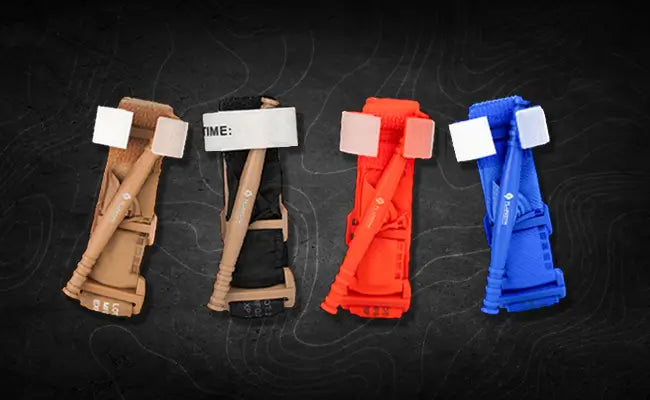
The most catastrophic failure point in high-heat environments is the polymer windlass of a tourniquet. Modern high-quality tourniquets use advanced glass-reinforced polymers designed to withstand immense torque. However, repeated thermal cycling—the constant heating during the day and cooling at night—leads to a phenomenon known as plasticizer migration.
As the plasticizers leach out of the polymer, the material becomes brittle. On a microscopic level, small fissures begin to form. In a high-stress emergency, when you apply the maximum 360-degree tension required to occlude an arterial bleed, a heat-degraded windlass may snap. This is a "silent failure" because the device looks perfectly functional upon visual inspection, but its mechanical load-bearing capacity has been compromised by the very environment it was stored in.
Critical Components Most Vulnerable to Heat
When auditing your gear after a hot season, pay special attention to these three categories:
-
Adhesives and Hydrogels: * The Risk: High heat causes the adhesives on chest seals and medical tapes to "melt" or lose their tackiness.
The Result: When applied to a sweaty or bloody patient, the seal may fail to stick, leading to a collapsed lung (tension pneumothorax).
-
Elasticity and Rubber Components: * The Risk: Heat breaks down the elastic fibers in pressure dressings and elastic wraps.
The Result: The bandage loses its "memory" and cannot provide the necessary compression to stop venous bleeding.
-
Hemostatic Agents (Chitosan/Kaolin): * The Risk: While the active minerals are relatively stable, the carriers or "strips" they are embedded in can become stiff or fused together.
The Result: Difficulty in unfolding the gauze quickly during a massive hemorrhage, costing precious seconds.
The Chemistry of Failure: Why Quality Matters
The difference between a professional-grade kit and a cheap imitation is found in the Polymer Stability Index. Budget-grade plastics used in counterfeit or "no-name" kits often use low-cost fillers that degrade rapidly at temperatures above 50°C. In contrast, the hardware in FlareSyn kits is engineered with high-thermal-threshold resins. While all materials eventually succumb to physics, professional gear provides a significantly wider "Safety Margin." In 2026, you aren't just paying for the tool; you are paying for the chemical resilience that ensures the tool works after 100 days of summer heat.
The Humidity Trauma Gear: Oxidation, Mold, and Seal Failures
While heat acts as a silent killer through molecular breakdown, humidity operates through a different, equally destructive mechanism: permeation and oxidation. In 2026, as shifting weather patterns bring tropical-level humidity to once-temperate urban zones, the threat to medical gear has escalated. High moisture content in the air doesn't just make a kit feel damp; it creates a microscopic gateway for pathogens and chemical degradation to bypass the very barriers designed to keep your gear sterile.
Moisture Ingress: The Invisible Enemy of Sterile Packaging
The primary defense of any Trauma Gear is its sterile packaging—typically a medical-grade laminate or plastic film. However, no flexible material is 100% impermeable to water vapor over long periods. Through a process called moisture vapor transmission, water molecules can slowly migrate through the microscopic pores of standard plastic wraps.
Once moisture enters a "sealed" dressing or gauze, it creates an incubation chamber. For hemostatic agents like Chitosan, which are derived from biological sources, excessive moisture can lead to clumping or even the growth of microscopic mold if the seal is compromised. More dangerously, moisture can cause the specialized adhesives on chest seals to undergo hydrolysis, a chemical reaction that breaks down the molecular bonds of the glue. When you finally peel that chest seal in a rain-soaked emergency, you may find it has the adhesive strength of a wet paper towel—a catastrophic failure when trying to seal a sucking chest wound.
Corrosion Science: When Metal Components Meet Tropical Humidity
Even the hard components of a trauma kit are not immune. Many "tactical" kits include shears, safety pins, or even metal windlasses on certain tourniquet models. In high-humidity environments—especially in coastal regions with salt-laden air—galvanic corrosion becomes a significant risk.
When two different metals come into contact in a humid environment, the moisture acts as an electrolyte, facilitating an electrochemical reaction that eats away at the structural integrity of the metal. A pair of trauma shears that has sat in a humid car for two years might look fine, but the central pivot bolt could be so corroded that it snaps the moment you try to cut through heavy denim or a leather boot. In 2026, "stainless" is a relative term; without proper environmental protection, even high-grade alloys are at risk of oxidation.
Material Resistance Matrix – High-Humidity Performance
This matrix compares how common medical gear materials withstand prolonged exposure to 80%+ humidity.
| Material | Resistance to Oxidation | Risk of Structural Failure | Common Components | Performance Note |
| Stainless Steel (304/316) | High | Low | Shears, Pivot Bolts | Highly resistant but prone to "pitting" in salt air. |
| Anodized Aluminum | Medium | Medium | Windlasses, Carabiners | Excellent weight-to-strength; can corrode if coating is scratched. |
| Modified Polymers | Maximum | Minimum | Buckles, TQ Windlasses | Best for 2026: Immune to rust; focus on UV protection instead. |
| Carbon Steel | Low | High | Cheap Shears, Pins | Found in budget kits; will rust shut in months. |
FlareSyn Integration: The Vacuum-Sealed Defense
At FlareSyn, we recognize that a standard plastic wrap is not enough for the 2026 environment. This is why our core trauma components utilize Advanced Vacuum-Seal Technology. Unlike "loose-pack" kits that trap ambient air—and thus ambient moisture—inside the packaging, our components are sealed in a high-pressure vacuum environment using multi-layered, puncture-resistant laminates.
By removing the air, we remove the vehicle for moisture. This "compressed" footprint not only saves space in your IFAK but acts as a definitive barrier against moisture ingress and oxidation. When you tear open a FlareSyn-sealed dressing, you are accessing an environment that has been frozen in time—protected from the humidity of the outside world until the exact second it is needed to save a life. This is the difference between a kit that "looks" ready and one that is scientifically guaranteed to be sterile and functional.
High-Altitude and Low-Pressure Logistics: The Physics of Thin Air
While heat and humidity are terrestrial enemies, altitude introduces a more cerebral challenge: Atmospheric Pressure Differentials. In 2026, as high-altitude trekking, alpine rescue, and rapid air transport become more common, the physical behavior of your trauma kit changes the moment you cross the 2,500-meter (approx. 8,200-foot) threshold. This is a technical domain where "standard" gear can fail not because of a manufacturing defect, but because of the laws of gas expansion.
Pressure Differentials: The "Ballooning" Effect
The most immediate physical change you will notice at altitude is that your vacuum-sealed or air-tight dressings begin to balloon. Because the air pressure inside the packaging (sealed at sea level) is higher than the thinning air outside, the internal gases expand. For a tightly packed IFAK, this "expansion" can cause the pouch to become rigid, making it difficult to open or, in extreme cases, causing the seams of the sterile packaging to rupture.
When a seal ruptures due to pressure, it is no longer a sterile barrier. More importantly, if you are using an "air-gapped" pouch (one that isn't vacuum-sealed but just zipped shut), the expansion can put immense stress on plastic components like the windlass of a tourniquet or the casing of a diagnostic device. In the alpine environments of 2026, understanding this "Inflation Stress" is vital for anyone operating in mountainous terrain or utilizing helicopter evacuation.
The Hypoxia Factor: Physiological Stress vs. Equipment Limits
At high altitude, the environment doesn't just attack the gear; it attacks the operator. Hypoxia (oxygen deprivation) impairs cognitive function and fine motor skills. In 2026, we have learned that gear designed for sea-level use often becomes a liability under hypoxic stress.
If your trauma kit requires complex finger movements or "fiddly" zippers that are now strained by internal pressure, the cognitive load of opening the kit can become overwhelming. Furthermore, certain medical liquids—like saline washes or antiseptic sprays—behave differently under low pressure, often "misting" or spraying uncontrollably when opened. The combination of a struggling brain and pressurized equipment creates a high-risk failure point in alpine medicine.
High-Altitude Best Practices for 2026 Responders
To ensure your gear remains functional at 3,000+ meters, follow these tactical adjustments:
Pre-Elevation Venting: For non-sterile storage containers, ensure there is a small pressure-relief valve or leave the zipper slightly cracked during ascent to allow for pressure equalization.
Vacuum-Seal Dominance: Prioritize gear that is High-Vacuum Sealed (like FlareSyn components). Because almost all air is removed during our manufacturing process, there is virtually no internal gas to expand at altitude, keeping the package slim and the seal intact.
Oversized Pull-Tabs: Replace standard small zippers with oversized paracord loops or "T-bar" pulls. This compensates for the loss of dexterity caused by hypoxia and the physical resistance of a pressurized pouch.
Liquid Stabilization: Switch from pressurized spray cans to individual-use "squeeze" ampoules for wound irrigation to prevent explosive depressurization when opened.
The Tactical Insight: Managing the Expansion
The core logic for the 2026 alpine responder is Volume Management. You must account for the fact that your kit will "grow" in volume as you climb. By choosing vacuum-sealed components, you aren't just saving space; you are mathematically reducing the risk of a "burst seal." In the thinning air of the high peaks, where every breath is a struggle, your gear should be the one thing that isn't under pressure. Whether you are a high-altitude hiker or a professional search-and-rescue operator, managing the physics of low pressure is as critical as managing the injury itself.
The 2026 Maintenance Protocol: Resilience Through Systematic Auditing
In the professional world of emergency medicine, we have a saying: "You don't rise to the level of your expectations; you fall to the level of your maintenance." By 2026, the complexity of our environments—ranging from urban heat islands to extreme coastal humidity—demands a shift from passive ownership to an active Maintenance Protocol. Resilience is not a one-time purchase; it is a state of perpetual readiness achieved through disciplined auditing. If you are not inspecting your gear, you are essentially carrying a box of "maybe."
Visual Inspection vs. The Tactical "Stress Test"
The most common mistake in gear maintenance is relying solely on a Visual Inspection. Glancing at your IFAK and seeing that the nylon is intact does not mean the tools inside are functional. A 2026-standard audit requires a deeper look. A visual check confirms that the sterile seals are not "ballooned" or punctured and that the expiration dates are legible.
However, a Tactical Stress Test involves physically interacting with the non-disposable hardware. This means checking the windlass of your tourniquet for any signs of "whitening" or stress fractures in the polymer—a clear indicator of UV or heat damage. It means cycling the zippers on your FlareSyn pouch to ensure no grit or salt corrosion has compromised the track. You aren't trying to break the gear; you are verifying its mechanical integrity. In a life-or-death moment, you cannot afford to discover that your shears are seized or your tourniquet has become brittle.
Inventory Rotation: The FIFO (First In, First Out) Method
Medical gear should be managed like a high-stakes logistics hub. The FIFO Method (First In, First Out) ensures that your oldest "in-date" gear is used for training or moved to the front of your Tier 3 home kit, while the freshest vacuum-sealed components are reserved for your high-stress Tier 1 and Tier 2 kits.
In 2026, we advocate for a "Training Rotation." When a piece of gear reaches 6 months from its expiration date, it shouldn't be thrown away; it should be pulled from the "Real-World" kit and used for hands-on drills. This not only keeps your skills sharp but ensures that the gear on your person is always in its peak chemical and physical state. This rotation creates a "Living Inventory" that adapts to the environment rather than decaying within it.
Recommended Audit Frequency by Environment
Different environments exert different levels of "Environmental Tax" on your gear. Use this matrix to schedule your 2026 inspections:
| Environment | Primary Threat | Visual Check Frequency | Stress Test Frequency | Component Rotation |
| Urban (Climate Controlled) | Dust/Minor Vibrations | Every 6 Months | Annually | Every 3–5 Years |
| Desert (High Heat/UV) | Polymer Embrittlement | Monthly | Every 3 Months | Every 1–2 Years |
| Maritime (High Salt/Humidity) | Metal Corrosion/Hydrolysis | Monthly | Monthly | Every 1 Year |
| Alpine (Pressure/Cold) | Seal Rupture/Elastic Failure | Every Trip | Every 6 Months | Every 2 Years |
FlareSyn Integration: Engineering for Longevity
At FlareSyn, we don't just design for the emergency; we design for the wait. Our hardware—from the reinforced windlasses to our laser-cut laminates—is engineered for Extended Duty Cycles. We utilize high-stability resins that resist the "plasticizer migration" common in cheaper alternatives, significantly extending the reliable lifespan of your hardware.
Furthermore, we recognize that the "Rotation" process can be a logistical headache. That is why FlareSyn offers a dedicated Refill & Subscription Service. We help you track your expiration dates and provide "Reload Packs" of sterile gauze, chest seals, and hemostatic agents at a discount when your current inventory nears its limit. This ensures that while the FlareSyn hardware stays as the durable backbone of your kit, the life-saving "software" inside is always fresh, sterile, and ready for the extreme demands of 2026. Consistent maintenance is the only way to guarantee that when the "Silent Failure" of the environment meets the "Loud Crisis" of an injury, your gear is the strongest link in the chain.
In the world of 2026 emergency preparedness, we must abandon the idea that medical gear is "buy-and-forget" insurance. The life-saving potential of your trauma kit is not a constant value—it is a variable influenced by every degree of temperature, every percentage of humidity, and every meter of elevation it endures. A tourniquet is only a life-saving tool if its polymers hold under tension; a chest seal is only functional if its hydrogel maintains its tackiness. When we ignore the environmental "tax" placed on our equipment, we aren't just carrying gear—we are carrying a false sense of security.
Reliability is a dynamic state that requires active participation. By understanding the material science of degradation and committing to a systematic audit protocol, you ensure that your "safety net" is actually capable of catching you when you fall. In a crisis, you will not have the time to question your equipment’s integrity. That confidence must be built today, in the quiet moments of maintenance, long before the adrenaline of an emergency takes over.
Don't wait for a catastrophic failure to reveal a degraded kit. Take five minutes today to audit your vehicle-based Tier 2 kit. Open the pouch, inspect the windlass of your tourniquet for whitening or brittleness, and verify that your vacuum-sealed dressings haven't "ballooned" or lost their airtight seal.
If you find signs of environmental stress—melted adhesives, rusted shears, or brittle plastics—replace them immediately. Your future self is counting on the decisions you make right now. Upgrade to FlareSyn’s high-stability hardware and vacuum-sealed refills to ensure that your gear is as resilient as the spirit of the person carrying it. Audit your gear, rotate your stock, and stay ready for whatever 2026 throws your way.
Q: Can I still use a tourniquet if the windlass shows slight "whitening"?
A: No. "Whitening" or stress marks on the polymer are a definitive sign of structural fatigue due to UV or heat exposure. If the plastic has begun to degrade at a molecular level, it may snap under the extreme torque required to stop an arterial bleed. Replace it immediately and keep the old one for "dry" training only.
Q: Is it okay to keep my trauma kit in the glove box instead of the trunk?
A: The glove box and center console often reach even higher temperatures than the trunk due to their proximity to the dashboard and direct sunlight through the windshield. If possible, store your Tier 2 kit in a shaded area under a seat or in a thermally insulated FlareSyn pouch to minimize thermal cycling.
Q: Does vacuum-sealing affect the performance of hemostatic gauze?
A: Not at all. In fact, vacuum-sealing is the superior method for 2026 environments. It prevents moisture ingress that can cause Chitosan or Kaolin to clump or lose effectiveness. FlareSyn vacuum-seals ensure the gauze remains sterile, dry, and easy to unfold in an emergency.
Q: How do I know if my chest seal’s adhesive has failed without opening it?
A: Look for "hydrogel migration" or discoloration through the clear side of the packaging. If the gel looks melted, separated, or has changed from clear to a cloudy yellow, the adhesive has likely undergone hydrolysis due to heat and humidity.


Elias.H.Hwang
Elias H. Hwang is a tactical medicine expert and lead contributor at FlareSyn. He specializes in emergency trauma protocols and preparedness education, helping civilians and professionals alike master the tools and skills needed to save lives in critical moments.


Deixar comentário
Este site é protegido por hCaptcha e a Política de privacidade e os Termos de serviço do hCaptcha se aplicam.