
Article: Hemostatic Gauze Comparison: Which Stops Bleeding Faster
Hemostatic Gauze Comparison: Which Stops Bleeding Faster
Quick Navigation
A deep laceration, a gunshot wound, or a workshop accident can turn a routine day into a race against blood loss in a matter of minutes. When a wound is bleeding heavily and direct pressure alone is not controlling it, the type of gauze inside your trauma kit becomes one of the most important decisions you can make before help arrives. Many people assume any roll of gauze will do the job, but severe, life-threatening bleeding behaves very differently from a minor cut, and the gauze you pack should match that reality.
This article is a practical hemostatic gauze comparison against standard plain gauze, written for people who carry an IFAK in a vehicle, range bag, backpack, or duty belt and want to understand what each product actually does. This content is for educational purposes only and is not a substitute for hands-on bleeding control training or professional medical advice. In any real emergency, call your local emergency number immediately and follow the guidance of trained responders.
By the end of this guide you will understand how hemostatic gauze works at a chemical level, where plain gauze still earns its place in a kit, and how to build a trauma kit that carries both intelligently rather than choosing one over the other by guesswork. This hemostatic gauze comparison is built around real field use and published training guidance, not marketing claims.


What Is Hemostatic Gauze and How Does It Work
Hemostatic gauze is a wound dressing impregnated with an active agent designed to accelerate the body's natural clotting process at the site of a bleed. Unlike plain gauze, which relies entirely on manual pressure to slow blood flow, hemostatic gauze actively participates in clot formation. The two most common active agents used in trauma-grade hemostatic gauze are kaolin, a mineral that activates the clotting cascade on contact with blood, and chitosan, a substance derived from shellfish that binds to red blood cells and forms a sticky plug independent of the body's own clotting factors.
Military and civilian trauma programs, including guidance referenced by the National Association of Emergency Medical Technicians, have driven widespread adoption of kaolin- and chitosan-based gauze because uncontrolled hemorrhage remains one of the leading causes of preventable death in trauma. When packed correctly into a wound cavity, hemostatic gauze can begin accelerating clot formation within roughly two to three minutes, compared with plain gauze, which depends solely on the patient's own circulatory pressure and clotting ability.
It is worth noting that hemostatic gauze is designed as a wound-packing agent for deep, severe, non-compressible bleeding, not as a general-purpose bandage for scrapes or shallow cuts. Using it correctly means packing it directly into the wound tract and holding firm, steady pressure, which is a different technique from simply laying gauze over a surface wound. Understanding this hemostatic gauze comparison starts with knowing exactly what makes the active agent chemically different from ordinary cotton gauze.


Plain Gauze: Strengths and Limits When Bleeding Is Severe
Plain gauze, sometimes called sterile gauze or combat gauze without a hemostatic coating, is still an essential, versatile item in any trauma kit. It is inexpensive, has an extremely long shelf life, and works well for cleaning wounds, padding injuries, securing dressings, and managing minor to moderate bleeding where direct pressure alone is enough to achieve control.
The limitation of plain gauze becomes clear with arterial or deep venous bleeding, where blood loss can exceed the rate at which the body's own clotting factors can respond. In these situations, plain gauze packed into a wound provides a physical barrier and a surface for pressure, but it does nothing chemically to accelerate clotting. For a minor kitchen cut, that is irrelevant. For a gunshot wound to the thigh or a deep laceration near a major vessel, relying on plain gauze alone can cost critical minutes that a hemostatic agent is specifically engineered to save.
A well-rounded trauma kit should never treat plain gauze and hemostatic gauze as interchangeable. Plain gauze remains the workhorse for everyday first aid and secondary dressing, while hemostatic gauze is reserved for the minority of injuries where blood loss is severe enough to be life-threatening. Any honest hemostatic gauze comparison must acknowledge that plain gauze still earns its place for everyday first aid even though it cannot match the chemical speed of a hemostatic agent.
Hemostatic Gauze Comparison: Side-by-Side With Plain Gauze
The clearest way to understand this hemostatic gauze comparison is to look at how each product performs across the factors that matter most in the field: how it stops bleeding, how much it costs, how long it lasts in storage, and how much training it requires to use correctly.
Clotting Mechanism and Speed
Plain gauze is entirely mechanical. It absorbs blood and provides a surface for pressure, but the actual clotting work is done by the patient's own body. Hemostatic gauze is chemically active: kaolin-based products trigger the intrinsic clotting cascade almost immediately on contact with blood, while chitosan-based products create a mechanical seal that works even in patients who are hypothermic, taking blood thinners, or otherwise have impaired natural clotting. This is precisely why most hemostatic gauze comparison studies referenced in tactical medicine courses rate hemostatic agents as significantly faster at achieving hemorrhage control in severe wounds.
Cost, Shelf Life, and Training Requirements
Plain gauze is cheap, often a few dollars for a multi-roll pack, and can last for years in storage with minimal degradation. Hemostatic gauze costs considerably more per unit, generally reflecting the cost of the active agent and the testing required for trauma-grade certification, and most manufacturers rate shelf life between three and five years depending on storage conditions. Training requirements also differ: plain gauze application is intuitive, while hemostatic gauze requires deliberate wound-packing technique, which is why organizations like the American Red Cross and NAEMT recommend hands-on bleeding control courses before relying on it in an emergency. This part of the hemostatic gauze comparison often surprises first-time buyers, since cost, shelf life, and training demands vary significantly between the two products.
| Factor | Plain Gauze | Hemostatic Gauze |
|---|---|---|
| Primary mechanism | Manual pressure only | Active clotting agent plus pressure |
| Best suited for | Minor to moderate bleeding, dressing changes | Severe, life-threatening, non-compressible bleeding |
| Typical cost per unit | Low | Moderate to high |
| Shelf life | Several years, minimal degradation | Roughly 3 to 5 years, check expiration date |
| Training needed | Minimal | Hands-on wound-packing practice recommended |
| Effective if patient is hypothermic or on blood thinners | Limited | Generally more reliable |
The table above summarizes the most important points of this hemostatic gauze comparison at a glance, and it is worth revisiting before you restock or redesign your kit.
When to Reach for Hemostatic Gauze Instead of Plain Gauze
Not every wound calls for a hemostatic agent, and knowing the difference matters both for your budget and for making the right call under pressure. Reach for hemostatic gauze when you see any of the following, and remember that for a limb wound a properly applied tourniquet usually comes first:
- Bleeding that is pulsing, spurting, or soaking through dressings faster than you can change them
- A deep wound in a junctional area such as the groin, armpit, or neck where a tourniquet cannot be applied
- Penetrating trauma from a gunshot, stabbing, or industrial accident where the wound tract is deep
- A patient who is pale, cold, confused, or showing other early signs of significant blood loss
Plain gauze remains the right first choice for shallow cuts, abrasions, post-surgical dressing changes, and any bleeding that slows meaningfully with a few minutes of firm direct pressure. If you are ever uncertain which category a wound falls into, apply firm pressure first, call emergency services, and escalate to a hemostatic agent if bleeding does not slow within the first couple of minutes of sustained pressure. The practical takeaway from this hemostatic gauze comparison is knowing exactly which wounds call for which product before an emergency forces the decision.
How to Pack Both Gauze Types in Your IFAK or Trauma Kit
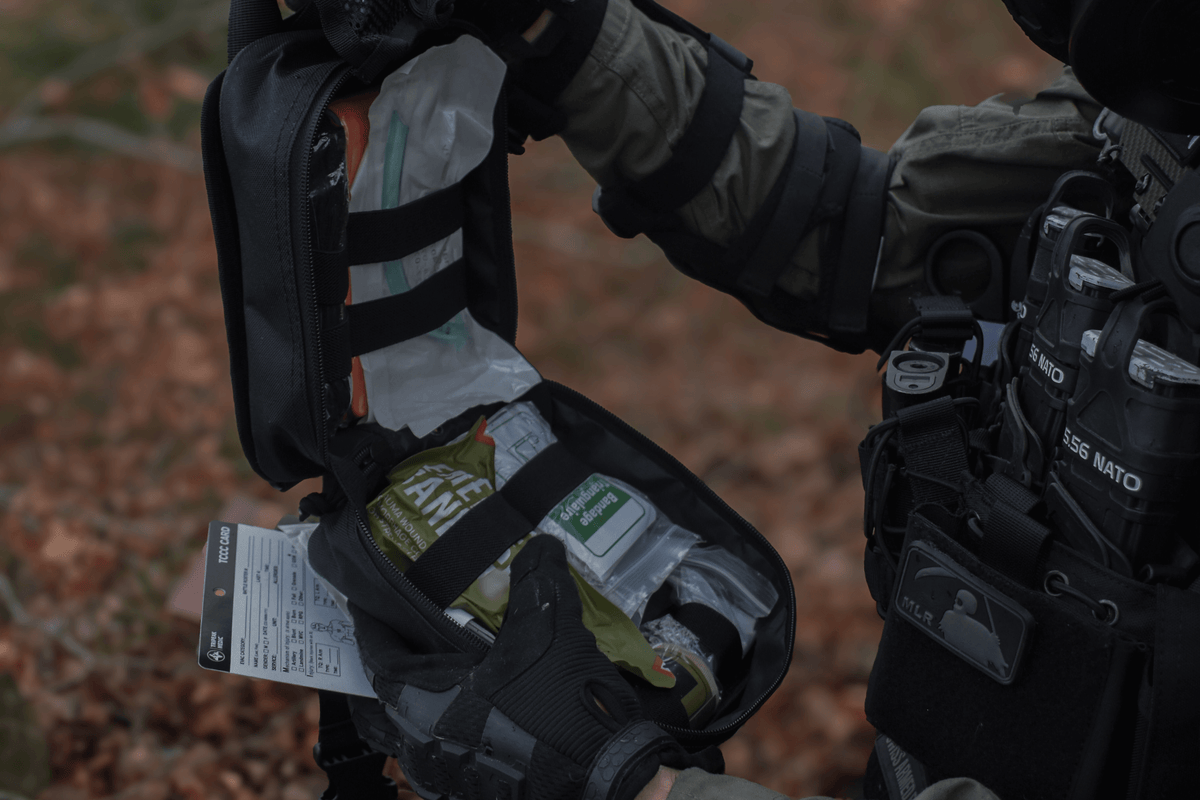
A trauma kit built around a single type of gauze is incomplete. The goal is a layered system where plain gauze handles the common, lower-severity injuries and hemostatic gauze is reserved and ready for the rare but dangerous ones. Applying the lessons of this hemostatic gauze comparison to your own kit means packing both products with intention, not guesswork. Our FlareSyn Compact Tactical Trauma IFAK is built around exactly this layered logic, pairing a dedicated hemostatic gauze slot with general-purpose dressing supplies in the same low-profile pouch.
When organizing your own kit, consider the following packing checklist:
- Keep at least one roll of hemostatic gauze in its original sealed packaging, separate from general supplies, so it is instantly identifiable under stress
- Store plain gauze and secondary dressings together for quick access to the items you will use most often
- Check expiration dates on hemostatic gauze every time you inspect your kit, since the active agent can lose effectiveness past its rated shelf life
- Label or color-code the hemostatic compartment so it is the fastest item to find in low light or high stress
- Replace any gauze immediately after use, rather than leaving a partially restocked kit for the next emergency
If you need to restock after using hemostatic or plain gauze in training or in a real response, our Advanced Emergency Wound Closure Kit is a practical way to replenish wound-care supplies alongside your gauze.
Common Mistakes When Applying Hemostatic Gauze
Even good gauze fails to perform if it is applied incorrectly. These are the most common mistakes people make under pressure, and many of them come directly from skipping the lessons of a proper hemostatic gauze comparison before an emergency happens:
- Laying gauze over the wound instead of packing it into the wound cavity. Hemostatic gauze must make direct contact deep inside the bleeding source to work; surface application wastes its chemical advantage.
- Releasing pressure too soon. Even after packing hemostatic gauze, continuous firm pressure for at least three minutes is typically required to allow a stable clot to form.
- Using expired product. An expired hemostatic agent may not activate the clotting cascade as reliably, which is why checking dates during kit inspection matters as much as carrying the product at all.
- Skipping training. Wound packing is a learned motor skill. Groups like the Stop the Bleed program and the American Red Cross both offer hands-on courses that build the muscle memory needed to pack a wound correctly under stress.
- Forgetting the tourniquet question first. For a bleeding limb injury, a properly applied tourniquet is often the first step before gauze is ever needed; hemostatic gauze is primarily for wounds where a tourniquet cannot be placed.
For limb injuries where a tourniquet is the appropriate first response, our best-selling trauma kits pair a quality tourniquet with hemostatic gauze so you are prepared for both compressible and non-compressible bleeding in the same loadout. This hemostatic gauze comparison underscores why limb bleeding usually calls for a tourniquet first, with hemostatic gauze reserved as the backup for wounds a tourniquet cannot reach.
Conclusion
Choosing between hemostatic gauze and plain gauze is not really a choice at all once you understand what each one is built for. Plain gauze is the reliable, low-cost workhorse for everyday cuts, scrapes, and dressing changes. Hemostatic gauze is a specialized, chemically active tool reserved for the rare moments when bleeding is severe enough to threaten a life within minutes. The strongest trauma kit carries both, stores them so the right one is easy to find under stress, and is backed by real hands-on training rather than good intentions alone. Review your kit regularly, replace anything expired or used, and treat this hemostatic gauze comparison as a starting point for a conversation with a certified instructor, not a replacement for one.
Conclusion
Airway management basics rarely get the spotlight that tourniquets and chest seals receive, but they sit at the same level of urgency in a real trauma timeline. Recognizing early signs of obstruction, using manual repositioning correctly, understanding when an NPA is appropriate, and defaulting to the recovery position for an unconscious but breathing casualty are all skills that fit into a few hours of hands-on training. None of this replaces certified instruction, and none of it replaces calling for professional help the moment a serious injury occurs. What it does is close the gap between an initial injury and the arrival of trained responders, which is the entire purpose of carrying a trauma kit in the first place. Treat these steps as a habit to rehearse occasionally rather than information to read once and forget, since muscle memory under stress is what actually makes a difference in a real emergency.
Q: Can hemostatic gauze be used on minor cuts and scrapes?
A: It can, but it is not necessary and is a poor use of an expensive, limited-shelf-life product. Plain gauze and a standard adhesive bandage are sufficient for minor wounds; revisit this hemostatic gauze comparison before you decide to swap one product for the other on a severe wound.
Q: How long does hemostatic gauze typically last in storage?
A: Most trauma-grade hemostatic gauze is rated for roughly three to five years when stored in its original sealed packaging away from extreme heat or moisture. Always check the printed expiration date during routine kit inspections.
Q: Do I need special training to use hemostatic gauze correctly?
A: Yes, hands-on practice is strongly recommended. Wound packing is a distinct technique from simply laying gauze over a cut, and organizations such as the American Red Cross and NAEMT offer bleeding control courses that teach correct application.
Q: Is hemostatic gauze a replacement for a tourniquet?
A: No. A tourniquet is generally the first response for severe limb bleeding when it can be applied above the injury. Hemostatic gauze is most valuable for junctional wounds and deep injuries where a tourniquet cannot be placed, such as the groin, neck, or armpit.


Elias.H.Hwang
Elias H. Hwang is a tactical medicine expert and lead contributor at FlareSyn. He specializes in emergency trauma protocols and preparedness education, helping civilians and professionals alike master the tools and skills needed to save lives in critical moments.

Laisser un commentaire
Ce site est protégé par hCaptcha, et la Politique de confidentialité et les Conditions de service de hCaptcha s’appliquent.