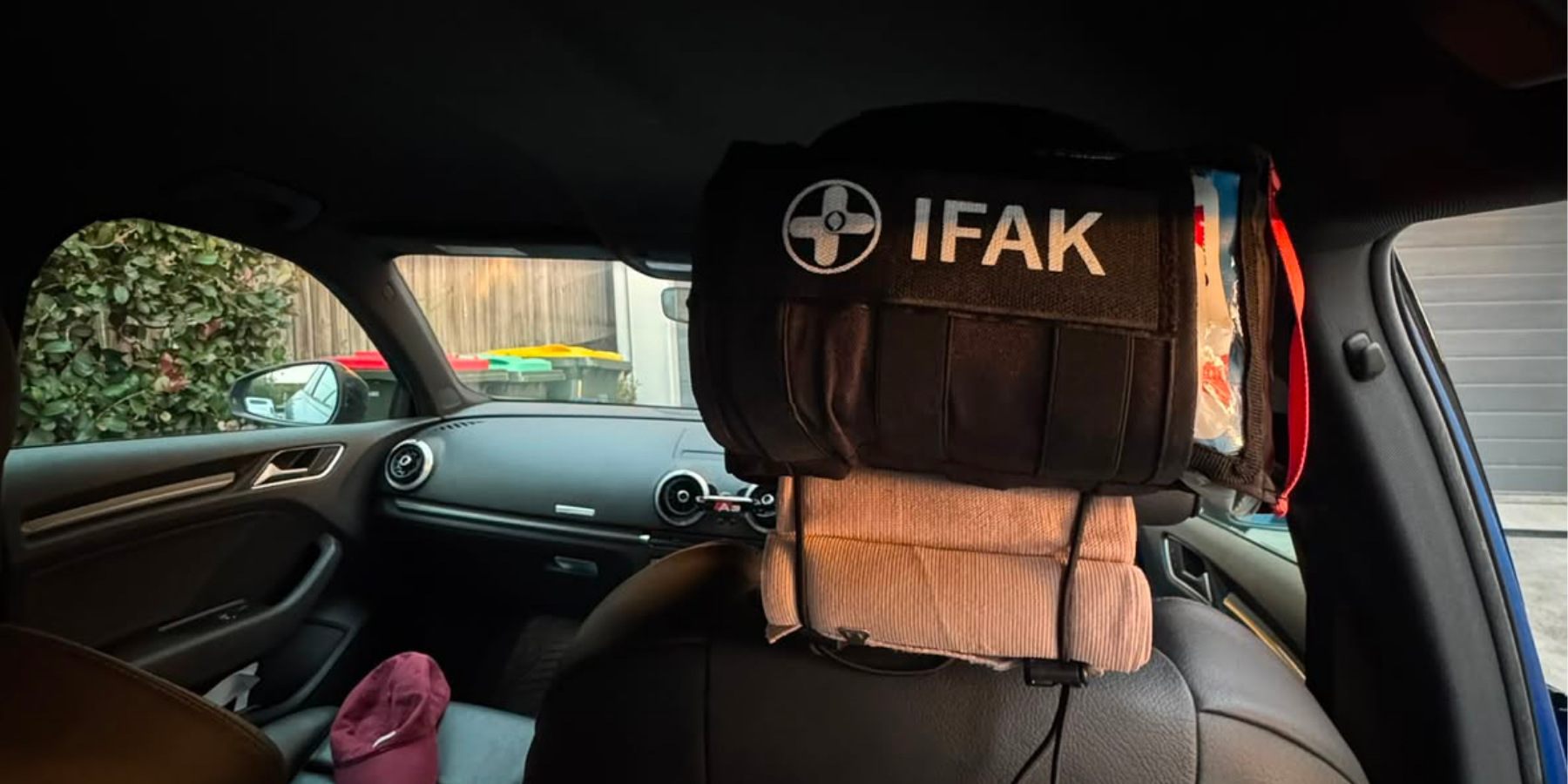
Australian Motorcycle Crash Vehicle IFAK Case
Australian Motorcycle Crash Vehicle IFAK Case
A real roadside response, shared to encourage preparedness
The value of a vehicle IFAK is easy to underestimate when it lives quietly in a car. It can look like another piece of gear: a pouch on a headrest, a bag behind a seat, something you hope never leaves its mount. Then a real event turns the question from “Do I need this?” into “Can I reach it, recognize what I need, and act within my training before professional help arrives?”
One publicly shared, de-identified account from Queensland, Australia offers a clear reminder. Roughly seven weeks before the account was posted, a driver came upon a serious motorcycle crash approximately two minutes after it happened. The rider had reportedly lost control at a roundabout, crossed to the other side of the road, and suffered severe bleeding from an arm. Two people were already trying to help, but the bleeding was not being effectively controlled.
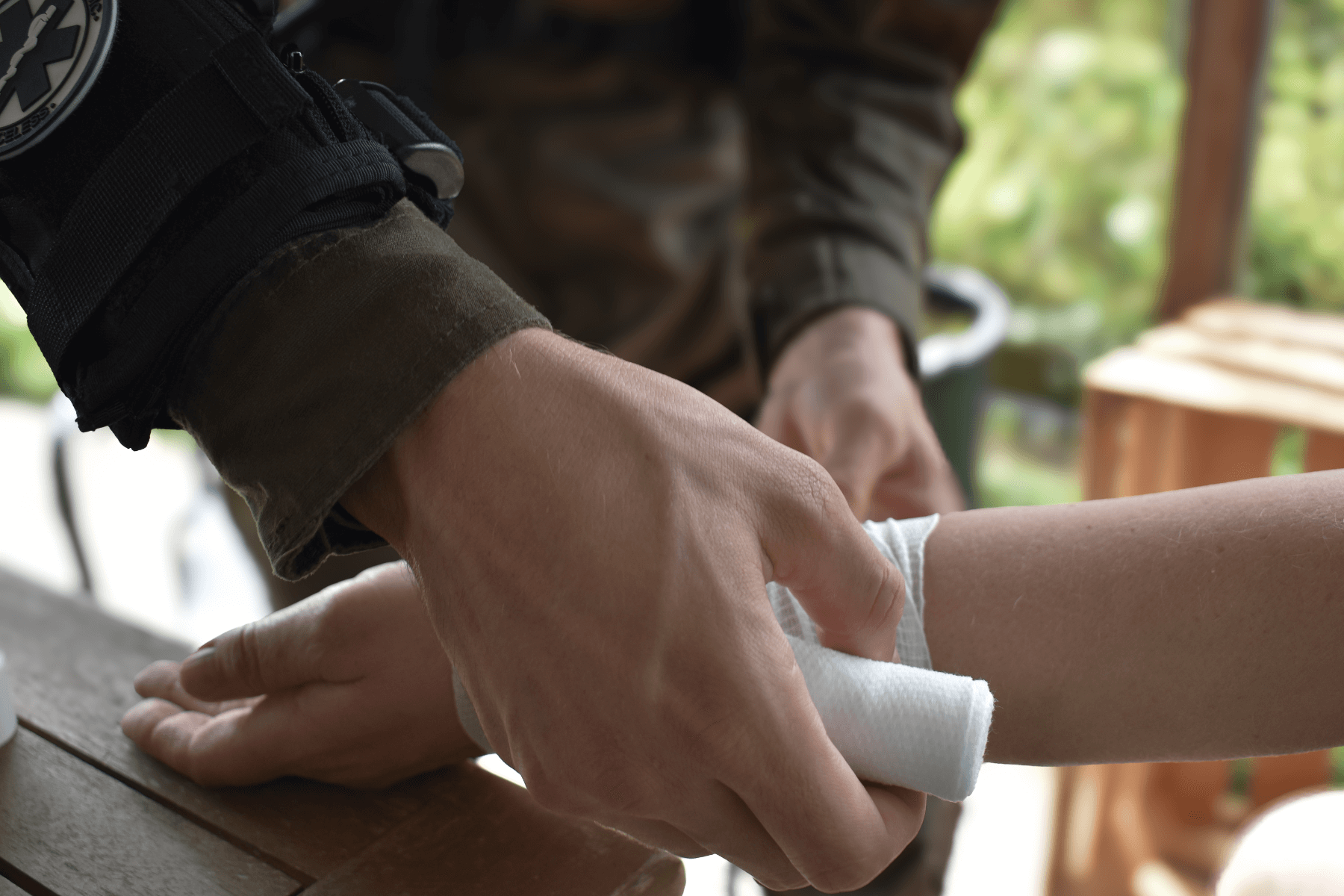
The driver had a trauma kit in the vehicle. He retrieved it, stepped in, and reported that he was able to control the bleeding until an ambulance arrived around ten minutes later. Paramedics took over, and the rider survived. The responder also said openly that he made mistakes during the incident, but that a foundation of first aid knowledge gave him a starting point. His message was direct: refresh skills, seek realistic professional training, and keep a properly equipped trauma kit in the vehicle.
This article is not a clinical case study and does not attempt to evaluate the care provided. It is an educational reflection on a publicly shared story. In any emergency, call local emergency services, protect yourself from scene hazards, and act only within your training and the instructions of qualified professionals or dispatch.


The first ten minutes are an access problem
- In this account, the responding driver arrived only about two minutes after the crash. That detail matters. A serious crash scene can be chaotic before official responders arrive: vehicles may still be moving, people may be frightened, and bystanders may have good intentions but no clear plan. The distance between “there is a kit somewhere in the car” and “the correct item is in someone’s hands” can shape the entire first response.
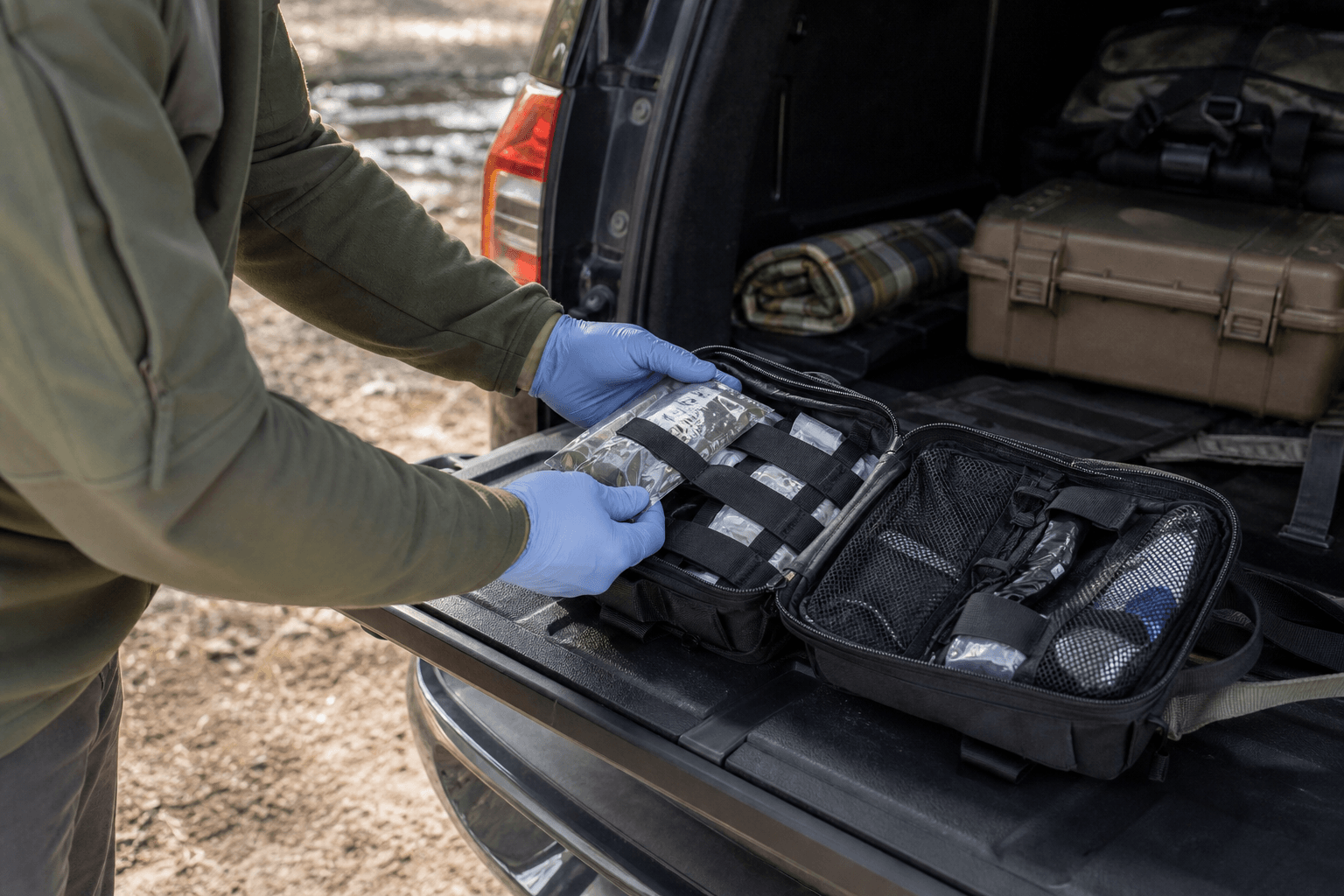
- A vehicle IFAK closes that gap when it is staged for immediate access. It should not be buried under luggage, hidden in an unmarked trunk tote, or mixed with routine travel items. A passenger should be able to retrieve it from one instruction. A driver should be able to remove it without emptying the vehicle. The pouch should open in a way that keeps key items visible instead of scattering them across pavement.
- In the Australian account, the kit’s importance was not that it was large or expensive. It was present, accessible, and carried by someone with enough prior training to recognize that the situation required action while help was en route. That combination—equipment, access, and a basic response foundation—is the real lesson.


A vehicle IFAK is not just a bag of supplies
An Individual First Aid Kit becomes useful when its layout matches the first minutes of a real emergency. The responder may be wearing gloves in poor light, kneeling on uneven ground, working around traffic, or trying to communicate with other bystanders. The kit must support a simple sequence rather than force a search through unrelated items.
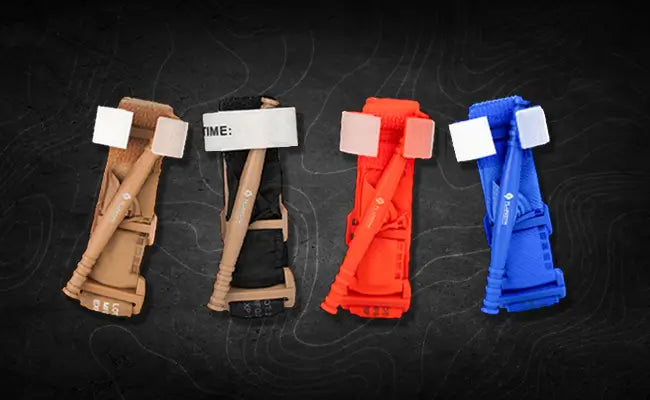
At a minimum, the kit should be built around the functions you have been trained to use: responder protection, immediate bleeding-control capability, tools to expose an injury, materials to maintain pressure or support wound care as appropriate, a way to note important information, and thermal protection. Specific contents, techniques, and quantities should match qualified instruction, local guidance, and the environment where the kit lives.
Organization is part of performance. Gloves should be easy to find first. Critical supplies should be clearly retained or labeled. Live, sterile supplies should be separated from training gear. The pouch should return to the same layout after every inspection. A kit that looks impressive when laid out on a table but becomes a tangled pile inside a vehicle is not ready for the road.
The scene may be more dangerous than the injury
Motorcycle crashes add another layer of risk. A rider may be in a traffic lane, near damaged vehicles, on a blind curve, or exposed to fuel, debris, glass, and other hazards. A well-equipped responder must still begin with scene safety. Call emergency services. Watch traffic. Use lights, high-visibility equipment, or other safe scene measures when appropriate. Do not create a second casualty by rushing into an unsafe roadway.
This does not make preparedness less important; it makes it more complete. A vehicle emergency system should include the medical pouch and a broader support layer: phone charging, light, high-visibility items, thermal protection, and a plan for communicating location and hazards to dispatch.
The difference between bystanders and an organized response
The account described two people already trying to help, but not effectively controlling the severe bleeding. That is not a judgment of those bystanders. Most people want to help, yet few have a practiced plan, suitable equipment, or confidence in what they have been taught. Under stress, good intentions can become hesitation.
Preparedness gives a group structure. One person calls emergency services and stays available for instructions. Another retrieves the kit. Someone else watches for traffic or directs arriving responders. The trained responder focuses on the immediate task within their competence. These roles are simple, but they prevent the common problem of three people searching for supplies while nobody communicates with dispatch.
The lessons translate beyond motorcycle crashes. A vehicle IFAK can support the first response to a serious laceration at a worksite, a farm injury, a roadside collision, an outdoor incident, or a medical emergency encountered while traveling. It does not predict the event. It makes the first minutes less dependent on luck.
Training turns equipment into capability
One of the strongest parts of the public account was the responder’s honesty. He did not present the event as a flawless demonstration. He said he made mistakes, but that his prior training gave him a foundation to work from. That is what realistic preparedness looks like.
No one should expect to perform perfectly during a serious incident. Stress narrows attention, reduces fine motor control, and changes how people communicate. Training cannot eliminate that pressure, but it can build a few dependable habits: recognize scene hazards, call for help early, find your equipment, use it only within your competence, and keep learning after the event.
Look for qualified, hands-on instruction that includes realistic scenarios and emphasizes the limits of civilian response. Ask instructors how to store equipment in vehicles, how to separate training supplies from live supplies, how to inspect a kit, and how to make a useful handoff to emergency services. Refresh the skills periodically. A course taken years ago is better than no course, but it may not be enough for confidence when something goes wrong today.
Practice the access, not just the technique
Practice should include the vehicle itself. Sit in the driver’s seat with the seatbelt on. Ask a passenger to find the kit. Remove it in low light. Open it without placing every item on the ground. Check whether the mounting system stays secure through normal driving but releases without a tool. Make sure your support gear does not block it after cargo is loaded.
These are small drills, but they reveal the failures that matter. A pouch may be excellent on a workbench and unusable when a cooler, a child seat, a jacket, and a road-trip bag fill the cabin. The goal is not to rehearse a dramatic scenario. It is to make access automatic.
Build a two-layer vehicle emergency system
The public story also reinforces why a single storage location is not enough. A compact, accessible vehicle IFAK should handle the first response. A deeper support bag can remain in the cargo area for additional supplies, replacements, warming layers, lighting, and trip-specific gear.
The rapid module belongs where the first responder can reach it. A headrest, seat back, or other secure cabin position often works well. The support module belongs where it can provide depth without slowing the first action. This two-layer design avoids the false choice between a small kit that is easy to reach and a large kit that has more capacity. Use both for different jobs.
After any real use, restock immediately. Treat opened, contaminated, damaged, or questionable items as no longer ready. Inspect the pouch, restore its layout, and make a short note about what was consumed. A kit that was used successfully once should not become an empty souvenir of the event.
What this Australian case should—and should not—teach us
It should teach us that emergencies can happen during ordinary travel. It should teach us that professional help can take minutes to arrive even in populated areas. It should teach us that a vehicle IFAK has value only when it is accessible and carried by someone willing to keep learning.
It should not encourage overconfidence, risky scene entry, or untrained medical intervention. The right response always begins with safety, emergency activation, and a realistic assessment of your own competence. The best kit is the one that supports responsible action and a fast handoff to professionals.
For drivers, that is a manageable standard. Mount the kit where it can be found. Keep it organized. Inspect it after heat, travel, training, and use. Teach passengers where it is. Take a credible course. Maintain a support layer in the vehicle. Those habits do not guarantee an outcome, but they give you a better starting point when the road becomes someone else’s worst day.
Conclusion
The Queensland motorcycle-crash account is a powerful reminder that preparedness is not abstract. A serious roadside incident unfolded; a bystander arrived with a trauma kit; emergency services followed; and a rider survived. We cannot know every detail of the care provided, and no one should turn another person’s injury into a simple product story. But the underlying lesson is sound: equipment, basic training, and timely action can matter before professional help takes over.
FlareSyn™ vehicle-ready IFAK systems are designed for that access problem. Stage the rapid module where it can be reached, protect the contents from the vehicle environment, carry a deeper support layer, and keep refreshing the skills that give the gear meaning. The road is unpredictable. Your first response does not have to be unprepared.
Q: What is a vehicle IFAK?
A: A vehicle IFAK is an Individual First Aid Kit staged in or on a vehicle for fast access during an emergency. It should be organized around the equipment and actions the user has been trained to perform while professional help is coming.
Q: Why not keep all emergency supplies in the trunk?
A: The trunk is useful for deeper supplies, but it may be blocked, hard to reach, or unsafe to access after a crash. A compact cabin-mounted module helps close the first-minute access gap.
Q: What should I do first at a roadside crash?
A: Prioritize your own safety and the safety of the scene, call local emergency services, and follow dispatch instructions. Use equipment only within your training and avoid entering hazardous traffic or unstable environments.
Q: How often should I refresh vehicle IFAK training?
A: Refresh regularly through qualified, hands-on instruction. Practice locating and opening your own vehicle kit before major trips and after any change to its location or layout.


Elias.H.Hwang
Elias H. Hwang is a tactical medicine expert and lead contributor at FlareSyn. He specializes in emergency trauma protocols and preparedness education, helping civilians and professionals alike master the tools and skills needed to save lives in critical moments.