L'importance des trousses de traumatologie pour le port quotidien
La vie ne donne pas d’avertissement avant qu’un accident ne survienne. Un accident de voiture sur une route de Casper, une chute au travail ou une blessure en extérieur lors d’une escapade de week-end peuvent devenir graves en quelques minutes. Dans ces premiers instants, les secours sont peut-être encore en route, mais le temps compte. C’est là que comprendre l’importance des kits de traumatologie pour le port quotidien devient concret et rassurant. Un kit de traumatologie offre aux particuliers un moyen de réagir calmement et en toute sécurité jusqu’à l’arrivée des professionnels. Il favorise la préparation sans la peur, et s’adapte aux situations réelles vécues par les familles, les navetteurs et les amateurs de plein air.
Qu’est-ce qu’un kit de traumatologie ?
Une erreur fréquente consiste à penser qu’un kit de traumatologie n’est qu’un nom plus chic pour une trousse de premiers secours. Pour être clair, un kit de traumatologie est un ensemble spécialisé d’outils médicaux destiné à traiter des blessures qui peuvent tuer une personne avant l’arrivée de l’ambulance. Alors qu’une trousse de premiers secours gère les problèmes « mineurs » comme de petites coupures, des maux de tête ou des ampoules, un kit de traumatologie est conçu pour les événements « majeurs ». Il se concentre sur les « trois grandes » causes de décès évitables : les hémorragies massives, les voies respiratoires obstruées et les blessures thoraciques qui empêchent une personne de respirer. Un vrai kit de traumatologie EDC est assez petit pour être porté tous les jours, mais assez puissant pour maintenir un cœur en activité en stoppant la perte de sang et en gardant les poumons fonctionnels.
Kit de traumatologie vs trousse de premiers secours : la différence entre survie et confort
La différence entre ces deux trousses, c’est la différence entre confort et survie. Si vous regardez une trousse remplie de pansements, de crème antibiotique et de pinces, vous avez sous les yeux une trousse de premiers secours. Un kit de traumatologie contiendra plutôt des éléments robustes comme des garrots à tourniquet, des agents hémostatiques qui coagulent rapidement le sang et des pansements thoraciques ventilés. Pour une configuration complète à Casper, vous pouvez emporter les deux, mais il faut bien comprendre que seul le kit de traumatologie est conçu pour sauver une vie lors d’un événement très stressant comme un accident de voiture ou une chute grave.
|
Caractéristique |
Trousse de premiers secours |
Kit de traumatologie (EDC) |
|
Objectif principal |
Confort et guérison légère |
Préservation de la vie (Stop the Bleed) |
|
Contenu type |
Pansements, pommade, aspirine |
Garrots, pansements thoraciques, QuikClot |
|
Urgence |
Pas de risque vital |
Immédiate (chaque seconde compte) |
|
Taille |
Peut être grande et encombrante |
Ultra-compact pour le port quotidien |
Pourquoi les kits de traumatologie pour le port quotidien (EDC) deviennent indispensables
Le port quotidien consiste à avoir des objets pratiques prêts pour des situations réelles. Les téléphones, lampes torches et outils de sécurité personnelle sont déjà courants. Les kits de traumatologie appartiennent désormais à cette même catégorie, car les urgences ne surviennent presque jamais dans des lieux ou à des moments idéaux.
À Casper, les longues distances en voiture, les activités de plein air et les changements météo peuvent rallonger les temps de réponse. Avoir un kit de traumatologie EDC comble cette lacune. Ces kits ne visent pas à remplacer les professionnels de santé. Ils servent à soutenir la réponse de base pendant ces premières minutes où l’action compte le plus.
Les raisons pour lesquelles davantage de civils portent un kit de traumatologie incluent :
-
Une réponse plus rapide en cas d’accident
-
Une sensibilisation accrue à la préparation aux urgences
-
Des formats compacts adaptés aux routines quotidiennes
Les urgences n’attendent pas les professionnels
Les services d’urgence font un excellent travail, mais ils ne peuvent pas être partout instantanément. Les premières minutes après une blessure grave déterminent souvent l’issue. Les kits de traumatologie soutiennent l’action précoce en se concentrant sur le contrôle des saignements et la protection.
Cette fenêtre de réponse précoce est souvent appelée « l’heure d’or », mais de nombreux gestes qui sauvent des vies surviennent bien avant cela. Même des actions simples, menées avec calme, peuvent réduire les risques avant l’arrivée des secours formés. Porter un kit de traumatologie soutient la responsabilité et la préparation sans nécessiter d’expertise médicale.
De l’usage tactique à la préparation civile
Les kits de traumatologie étaient d’abord courants dans les milieux militaires et médicaux d’urgence. Avec le temps, des versions plus sûres et plus simples sont devenues accessibles au grand public. Ces kits conçus pour les civils retirent les éléments inutiles et se concentrent sur les outils essentiels.
Les kits de traumatologie EDC modernes :
-
Sont plus légers et plus faciles à porter
-
Évitent les équipements compliqués
-
Se concentrent sur les scénarios d’accident courants
Cette évolution a rendu les kits de traumatologie adaptés aux familles, aux travailleurs et aux voyageurs dans tout le Wyoming.
À quelles blessures un kit de traumatologie EDC peut-il venir en aide ?
Une idée reçue fréquente est que l’équipement médical ne sert qu’aux urgences extrêmes, façon film. En réalité, un kit de traumatologie est conçu pour gérer les blessures les plus courantes et vitales rencontrées dans les accidents du quotidien, des collisions sur l’I-25 aux incidents sur un chantier de Casper. L’objectif principal d’un kit EDC est de stabiliser les blessures qui provoquent une perte de sang rapide, comme des lacérations profondes ou des plaies pénétrantes.
En ayant les bons outils sous la main, vous pouvez traiter une hémorragie artérielle, qui peut entraîner une perte de conscience en quelques secondes. Au-delà des saignements, un kit bien équipé permet aussi de stabiliser une « plaie thoracique aspirante » ou de gérer une obstruction des voies respiratoires, afin que la victime continue à recevoir de l’oxygène jusqu’à son transfert vers un centre de traumatologie professionnel.
Composants essentiels d’un kit de traumatologie pour le port quotidien efficace
Un kit de traumatologie pour le port quotidien repose sur un petit ensemble d’éléments essentiels qui permettent d’agir vite en cas de blessure grave. Chaque composant a un rôle précis et est choisi pour sa fiabilité sous pression. Pour les habitants de Casper qui passent du temps à conduire sur de longues distances, à travailler de leurs mains ou à profiter des activités de plein air, ces kits offrent un soutien pratique sans ajouter de poids ni d’encombrement inutiles. L’accent est toujours mis sur la rapidité, la facilité d’utilisation et l’aide à la stabilisation de la situation jusqu’à l’arrivée des secours.
Éléments essentiels pour le contrôle des saignements
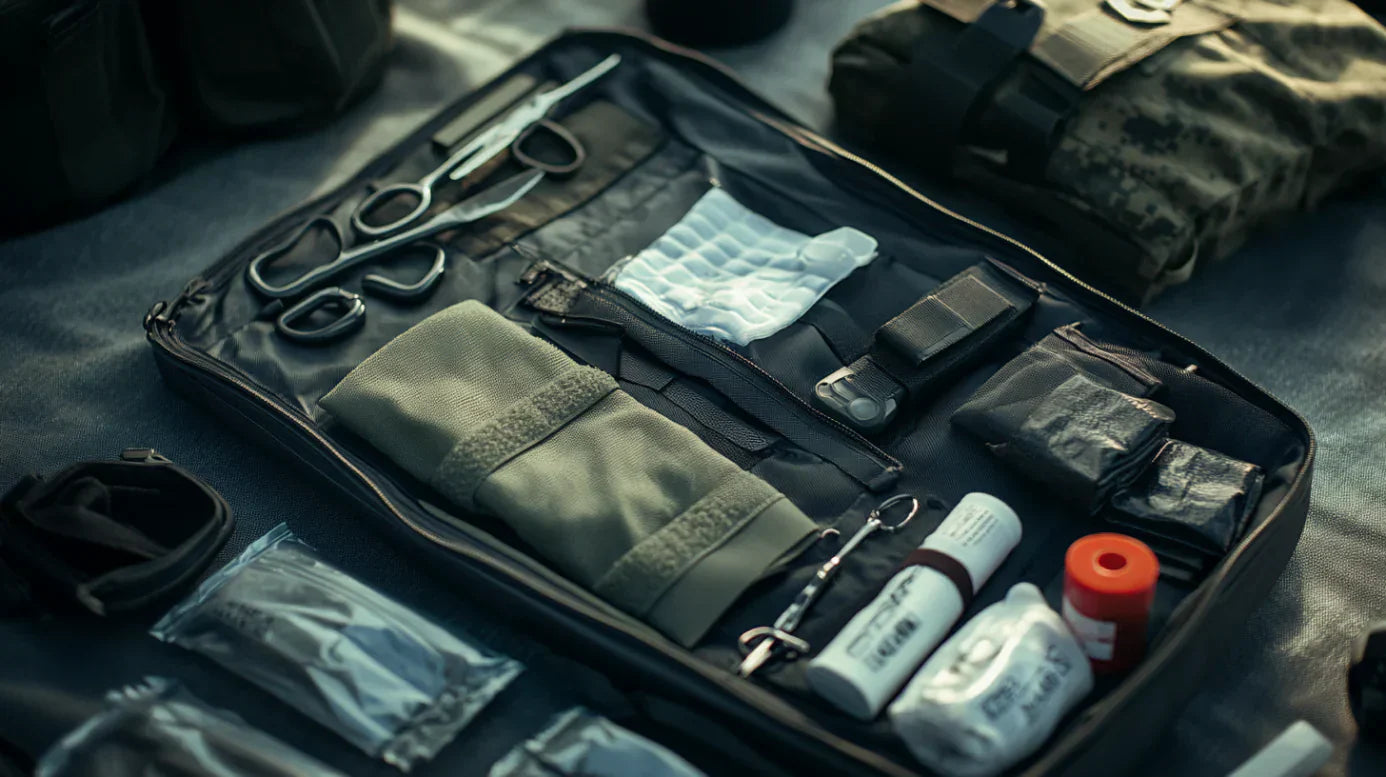
Le contrôle des saignements est au cœur de chaque kit de traumatologie, car une forte perte de sang peut devenir dangereuse en quelques minutes. Des garrots sont souvent inclus pour aider à gérer les hémorragies graves des membres, tandis que des bandages de compression exercent une pression constante sur les plaies. La gaze hémostatique est souvent ajoutée parce qu’elle aide à mieux contrôler les saignements que la gaze standard. Ces éléments sont compacts, largement reconnus pour un usage civil et conçus pour rester en place une fois appliqués, ce qui les rend adaptés aux urgences réelles du quotidien.
Soutien des voies respiratoires et de la respiration (vue d’ensemble)
Certains kits de traumatologie pour le port quotidien incluent des éléments de base qui contribuent à la sécurité respiratoire lors de certaines blessures. Ces outils sont simples et privilégient la protection plutôt que des soins avancés. Les pansements thoraciques et les masques de RCP, par exemple, aident à réduire les risques supplémentaires en attendant les secours formés. Ils sont inclus comme soutien préventif et ne visent pas à remplacer un traitement médical professionnel. Leur présence reflète une approche réfléchie de la préparation aux urgences, sans complexité inutile.
Protection des plaies et éléments de sécurité
Les éléments de protection et de soutien jouent un rôle important pour garder les urgences sous contrôle. Les gants en nitrile aident à réduire les risques de contact pour la personne blessée comme pour l’intervenant. Les cisailles de traumatologie permettent de retirer les vêtements en toute sécurité sans causer de blessure supplémentaire, tandis que les pansements de protection aident à couvrir les plaies pendant les déplacements ou le transport. Ces éléments favorisent une réponse plus sûre et aident à éviter des complications supplémentaires pendant un moment déjà stressant.
Format compact pour le port quotidien
Un kit de traumatologie EDC efficace doit s’intégrer aux routines quotidiennes. Si un kit est trop volumineux ou difficile à transporter, il est souvent laissé de côté. C’est pourquoi la compacité est essentielle. Les pochettes fines se glissent facilement dans un sac à dos, une boîte à gants ou un sac de travail, tandis que les agencements organisés permettent un accès rapide lorsque le temps manque. Des matériaux durables garantissent que le kit résiste à un usage régulier, ce qui est particulièrement important pour les habitants de Casper qui dépendent de leur véhicule et de leur équipement de plein air toute l’année. Flaresyn répond à ce besoin en proposant des solutions axées sur la sécurité, construites autour d’un usage pratique et d’un objectif clair.
Logistique du port : comment porter son matériel médical
Le meilleur kit de traumatologie au monde ne sert à rien s’il reste à la maison lorsqu’un accident se produit. Pour les habitants de Casper, la « logistique du port » consiste à trouver une manière de garder son équipement accessible sans qu’il soit encombrant ou inconfortable. Beaucoup de professionnels choisissent le Port à la cheville, à l’aide d’une pochette fine dissimulée sous la jambe du pantalon, ce qui permet de le porter facilement même dans un cadre de bureau. D’autres préfèrent les IFAK de poche (kits de premiers secours individuels) qui tiennent dans une poche cargo ou une poche arrière. Pour ceux qui ne veulent rien sur eux, le Port hors du corps dans un sac à dos quotidien ou un kit dédié au véhicule garantit que les outils qui sauvent des vies restent toujours à portée de main.
|
Type de port |
Idéal pour |
Avantages |
Inconvénients |
|
Pochette de cheville |
Employés de bureau / navetteurs |
Très discret, toujours sur soi |
Limité aux éléments fins |
|
Pochette de poche |
Tenue décontractée / plein air |
Accès extrêmement rapide |
Peut sembler lourd dans une seule poche |
|
Sac à dos / bandoulière |
Étudiants / voyageurs |
Peut contenir plus de matériel (cisailles, etc.) |
Pas toujours sur votre corps |
|
Montage dans le véhicule |
Conducteurs / familles |
Accessible à tous les passagers |
Utile seulement à proximité de la voiture |
Comment choisir le bon kit de traumatologie pour le port quotidien
Choisir le bon kit de traumatologie commence par comprendre comment et où il sera porté. Un kit de port quotidien doit correspondre à votre routine, que cela signifie le garder dans un véhicule, un sac à dos ou un sac de travail. La taille compte, car un kit trop grand est souvent laissé derrière. Un bon kit de traumatologie EDC reste compact tout en incluant les éléments essentiels pour le contrôle des saignements et une protection de base. La qualité compte aussi, car les fournitures de qualité médicale résistent mieux en situation d’urgence réelle et offrent des performances plus fiables quand le temps est compté.
Portabilité et options de port adaptées à la vie quotidienne
Les kits de traumatologie pour le port quotidien existent sous différents formats, chacun adapté à des besoins spécifiques. Les kits de poche conviennent bien à un port minimal, tandis que les kits pour sac à dos ou sac bandoulière offrent plus d’espace sans devenir encombrants. Les kits embarqués dans le véhicule sont courants à Casper en raison des longs trajets et des conditions météo changeantes. L’essentiel est de choisir une option de port qui vous accompagne de manière constante. L’accessibilité compte davantage que la quantité d’éléments qui ne seront peut-être jamais utilisés.
Kits prêts à l’emploi vs kits personnalisés
Certaines personnes préfèrent les kits de traumatologie prêts à l’emploi parce qu’ils sont assemblés par des professionnels et reposent sur des éléments éprouvés. Ces kits évitent les hésitations et font gagner du temps. Les kits personnalisés, en revanche, permettent d’adapter le contenu au mode de vie ou au niveau de confort. Les deux options peuvent très bien fonctionner, à condition que le kit reste centré sur la réponse d’urgence plutôt que sur les premiers secours généraux. Pour de nombreux habitants de Casper, commencer avec un kit prêt à l’emploi fiable est une première étape pratique.
Comprendre la responsabilité et l’usage sécurisé
Porter un kit de traumatologie implique aussi une responsabilité. Ces kits sont faits pour aider à stabiliser la situation en attendant les secours, pas pour remplacer des soins médicaux formés. La sensibilisation de base et une réponse calme comptent plus que des connaissances avancées. Beaucoup de personnes choisissent de participer à des sessions communautaires de sécurité ou de sensibilisation au contrôle des saignements pour se sentir plus confiantes. Savoir quand agir et quand se retirer fait partie d’une préparation responsable.
Entretien et contrôles du kit : la règle des 6 mois
Un kit de traumatologie n’est pas un outil qu’on « règle et qu’on oublie ». Pour garantir que votre équipement fonctionne quand vous en avez besoin, vous devez effectuer un contrôle médical tous les six mois. Au Wyoming, les écarts extrêmes de température entre un hiver glacial et un été chaud peuvent faire sécher les adhésifs des pansements thoraciques ou rendre le plastique d’un garrot cassant. Vérifiez votre Gaze hémostatique pour les dates de péremption, car les agents chimiques peuvent perdre de leur efficacité avec le temps. Assurez-vous que tous les emballages stériles sont toujours sous vide ; si un sceau est rompu, l’article est contaminé et doit être remplacé. Une vérification rapide deux fois par an garantit que votre équipement FlareSyn est en parfait état et prêt pour le terrain.
Foire aux questions
Puis-je utiliser une ceinture comme garrot ?
Même si c’est un cliché fréquent au cinéma, une ceinture échoue presque toujours comme garrot. Les ceintures sont trop larges pour créer la pression concentrée nécessaire pour arrêter le flux sanguin artériel et se cassent souvent avant d’être suffisamment serrées. Il vaut toujours mieux porter un garrot dédié à tourniquet.
Est-il légal d’emporter un kit de traumatologie dans un aéroport ?
Oui, les kits de traumatologie sont généralement autorisés par la TSA. Les garrots, la gaze et les pansements thoraciques ne sont pas considérés comme des armes. Toutefois, vous devez vérifier que votre kit ne contient pas de grandes cisailles de traumatologie (plus de 4 inches) ni de scalpels tranchants si vous prévoyez de le transporter en cabine.
Qu’est-ce que le protocole MARCH pour les civils ?
MARCH est une liste simple de priorités : Massive hémorragie, Airways (voies respiratoires), Respiration, Circulation, et Hypothermie. Il indique exactement ce qu’il faut traiter en premier pour donner à la victime la meilleure chance de survie.
Combien coûte un bon kit de traumatologie EDC ?
Un kit fiable et de haute qualité coûte généralement entre $60 et $150. Même si vous pouvez trouver des options moins chères, il est essentiel d’éviter le matériel de contrefaçon, en particulier les garrots, qui peuvent casser quand vous essayez de les serrer. Investir dans des composants authentiques de qualité médicale n’est pas négociable.
Conclusion : porter la responsabilité de la vie
Porter un kit de traumatologie est un choix pratique qui montre que vous accordez de l’importance à la vie de ceux qui vous entourent. C’est un petit poids à porter comparé à celui de l’impuissance face à une tragédie. Que vous alliez travailler à Casper, exploriez les sentiers de montagne ou passiez simplement du temps en famille, avoir un kit FlareSyn à portée de main signifie que vous êtes prêt pour l’imprévu. La vraie préparation consiste à réunir le bon équipement, la bonne formation et un état d’esprit responsable. Évaluez dès aujourd’hui votre port quotidien actuel : ajouter quelques onces d’équipement médical pourrait être la décision la plus importante de votre vie.