
The MARCH Protocol: A Civilian Guide to Managing Trauma Under Pressure
🛡️ Written by: Elias.H.Hwang (Certified NAEMT Member) | 🔬 Medically Reviewed by: Dr. Alan Hastings, TCCC Certified Instructor / Paramedic Expert on April 27, 2026.
Mastering Trauma Care Under Stress
In the seconds following a violent accident—a high-speed collision, a workplace mishap, or a severe fall—the most dangerous threat isn't just the injury itself; it is the "Fog of War." Even for those with basic first-aid knowledge, the sudden surge of adrenaline can cause a psychological phenomenon known as cognitive tunneling. Your heart rate spikes, your peripheral vision narrows, and the brain’s executive function begins to degrade. This is why even medical professionals can occasionally freeze when faced with the raw, chaotic reality of a trauma scene without the sterile safety of a hospital. For a civilian, this mental paralysis can be fatal. When you don't know what to do first, you often end up doing nothing at all
The solution to this psychological barrier is not found in more textbooks, but in a structured cognitive "railroad" known as the MARCH Protocol. Originally developed for tactical combat casualty care (TCCC), MARCH is a prioritized sequence of life-saving actions designed to be executed under extreme stress. It functions as a mental checklist that filters out the noise of a chaotic environment, forcing the responder to focus on the most immediate threats to life in a specific, logical order. By following MARCH, you stop reacting to the scene and start managing the patient. You move from a state of overwhelmed panic to a state of systematic execution.
The thesis of modern preparedness is simple: You do not rise to the level of your expectations; you fall to the level of your training and your gear. At FlareSyn, we believe that professional-grade outcomes should be accessible to every citizen. By integrating the MARCH Protocol with a high-performance system, you transform from a bystander into a decisive responder. In this guide, we will break down each phase of the protocol, showing you exactly how to identify life-threatening injuries and which specific FlareSyn tools are required to stop the clock. It is time to move from "Panic" to "Protocol."


M is for Massive Hemorrhage: The First 60 Seconds
In the MARCH hierarchy, the "M" stands for Massive Hemorrhage, and it sits at the very top for a singular, biological reason: you can bleed to death from a compromised major artery faster than you can suffocate from a blocked airway. While a person may survive several minutes without oxygen, a high-pressure femoral or carotid bleed can lead to exsanguination (bleeding to death) in as little as 120 to 180 seconds. In the context of a trauma scene, "M" is the immediate priority. If you do not stop the massive bleeding, the rest of the MARCH steps become irrelevant.
Why Bleeding Comes First: The Biological Priority
Blood is the delivery system for oxygen and the regulator of systemic pressure. When massive hemorrhage occurs, the body quickly loses its ability to transport oxygen to the brain and vital organs. More critically, as blood volume drops, the heart can no longer maintain the pressure required to circulate what little remains—a state known as hemorrhagic shock. This process is exponential. Once the body loses its "clotting factors" along with the escaping blood, the internal systems for stopping the bleed shut down entirely. To save a life, you must mechanically or chemically intervene before the body’s tank runs dry.
Identifying "Kill Zones": Life-Threatening vs. Minor Bleeds
Not all blood requires a tourniquet. A civilian responder must be able to distinguish between a "nuisance bleed" and a "life-threat." In tactical medicine, we look for Kill Zone indicators:
Pulsatile or Spurting Blood: This indicates an arterial breach.
Pooling on the Ground: If a puddle is rapidly expanding (roughly the size of a dinner plate or larger), it is a massive hemorrhage.
Overlaid Clothing is Soaked: If blood is quickly saturating thick fabrics like denim or canvas.
Amputations: Any partial or full loss of a limb is an automatic "M" priority.
Tool Selection: Tourniquet vs. Hemostatic Gauze
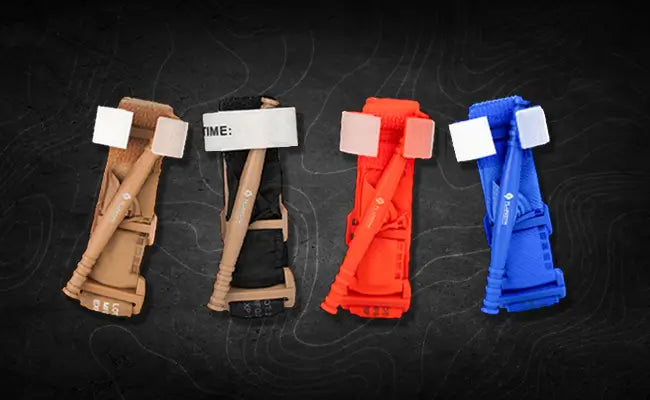
The decision between a tourniquet and gauze is a matter of anatomy. For injuries to the extremities (arms and legs), the FlareSyn Tactical Tourniquet is your first choice. It provides the mechanical occlusion necessary to shut down arterial flow completely. However, if the bleed is in a "junctional" area—such as the groin, armpit, or neck—a tourniquet cannot be applied. In these cases, you must use wound packing with FlareSyn Chitosan Hemostatic Gauze. By packing the gauze directly into the wound track and applying manual pressure, you create a chemical "plug" where a mechanical strap cannot reach.
A & R – Airway and Respiration: Managing the Breath of Life
Once the "M" phase is secured and massive bleeding is controlled, we move to the respiratory system. In the MARCH protocol, "A" and "R" represent the mechanical and physiological process of breathing. If the body is a machine, blood is the fuel, but oxygen is the spark. Without a clear path for air to enter the lungs (Airway) and a functional bellows system to move that air (Respiration), the patient will succumb to hypoxia within minutes.
A is for Airway: The Path of Least Resistance
An unconscious patient is at immediate risk of airway obstruction. In a trauma scenario, this is often caused by the tongue relaxing and blocking the throat, or by blood, teeth, and debris from facial trauma.
The first step in Airway management is simple: Clear and Maintain. For a civilian responder, this means checking the mouth for obstructions and utilizing the "Head-Tilt, Chin-Lift" maneuver (unless spinal injury is suspected). If the patient is breathing but unconscious, we utilize the Position of Recovery (rolling the patient onto their side). This uses gravity to ensure the tongue stays forward and fluids drain out of the mouth rather than into the lungs. At this stage, your goal is to ensure that the "pipes" are open before you worry about the "pump."
R is for Respiration: The Danger of the Collapsed Lung
While "Airway" is about the throat and mouth, Respiration is about the integrity of the chest cavity. The most terrifying respiratory threat in trauma is the Tension Pneumothorax (a collapsed lung). This occurs when a wound to the chest allows air to enter the space between the lung and the chest wall.
With every breath the patient takes, air is sucked into this cavity but cannot escape. This creates increasing pressure that eventually collapses the lung and, in extreme cases, pushes against the heart, stopping it from beating. This is a mechanical failure that requires immediate intervention. If you see a "sucking" chest wound—where air is visibly or audibly entering a hole in the torso—you are looking at a countdown to respiratory collapse.
The Science of Sucking Chest Wounds: Why Bandages Fail
A common mistake is attempting to treat a chest wound with standard gauze or duct tape. This is dangerous. A simple bandage acts as a one-way valve in the wrong direction: it traps air inside the chest cavity, accelerating the development of a Tension Pneumothorax.
To treat a "sucking chest wound" properly, you need a Vented Chest Seal. The science behind a vented seal is a "one-way valve" system: it allows air and blood to escape the chest cavity when the patient exhales, but prevents air from being sucked back in when they inhale. This stabilizes the pressure within the thorax and buys the patient time until they can reach a trauma surgeon.
C & H – Circulation and Hypothermia: The Invisible Killers
After securing the "M," "A," and "R," many responders mistakenly feel the crisis has passed. However, the patient now faces the "Invisible Killers." In the MARCH protocol, Circulation and Hypothermia address the systemic collapse of the body’s internal environment. Even if the bleeding has stopped, the patient can still die from the metabolic aftermath of trauma.
C is for Circulation: Assessing the Internal Pump
While "Massive Hemorrhage" focuses on external blood loss, Circulation is about what is happening inside the vessels. A responder must assess for Shock—the state where the body's organs are no longer receiving adequate blood flow.
To assess circulation, look for three clinical indicators:
Skin Condition: Is the skin pale, cool, or clammy? This is a sign the body is shunting blood away from the skin to protect the heart and brain.
Radial Pulse: If you cannot feel a pulse at the wrist but can feel one at the neck (carotid), the patient’s blood pressure is dangerously low.
Mental Status: Is the patient confused, agitated, or drifting into unconsciousness? An altered mental state in a trauma victim is "shock until proven otherwise."
At this stage, if you haven't already, you must ensure all minor bleeds are bandaged and that any previous life-saving interventions (like tourniquets) are still holding firm.
H is for Hypothermia: A Medical Necessity, Not a Comfort
The most common mistake in civilian trauma care is ignoring Hypothermia. You may be in a 90-degree desert, but a trauma victim can still die of cold. When a person loses blood, they lose their ability to regulate body temperature.
Hypothermia in trauma is not about "feeling cold"; it is a metabolic disaster. As the body temperature drops, the blood loses its ability to clot. This creates a feedback loop: the colder the patient gets, the more they bleed, and the more they bleed, the colder they get. Keeping a patient warm is as critical as stopping the bleeding itself. You must insulate the victim from the ground and wrap them in a thermal barrier immediately after the "R" phase is complete.
The Lethal Triad: The Science of Survival
In trauma medicine, we fight the Lethal Triad: the combination of Hypothermia, Acidosis (acid buildup in the blood), and Coagulopathy (the inability to clot). These three conditions reinforce each other. Once a patient enters this spiral, even a surgeon in a high-tech operating room may not be able to save them. The "H" in MARCH is your primary weapon against this triad. By maintaining the patient's core temperature, you are protecting their blood chemistry and keeping the "biological factory" running.
| Feature | M (Massive Hemorrhage) | C (Circulation/Shock) |
| Primary Goal | Stop "Spurting" or "Pooling" blood. | Maintain systemic blood pressure. |
| Key Indicator | Visible external trauma. | Pale skin, weak pulse, confusion. |
| Primary Tool | Tourniquet or Hemostatic Gauze. | Pressure dressings and Thermal Blankets. |
| Biological Impact | Rapid volume depletion. | Organ failure and metabolic collapse. |
The "FlareSyn MARCH" Workflow: Integrating Gear into Every Step
Understanding the science of the MARCH Protocol is only half the battle; the real test is execution. In a high-stress scenario, a major obstacle is often the chaos of your own equipment. If your patient is bleeding to death and you have to dump the entire contents of a cluttered medical bag onto the ground just to find your tourniquet, you are losing valuable seconds. To survive the "Fog of War," your equipment layout must reflect your cognitive protocol. The organization of your gear should guide your hands automatically through the steps of survival.
Layout for Success: Modularizing Your IFAK
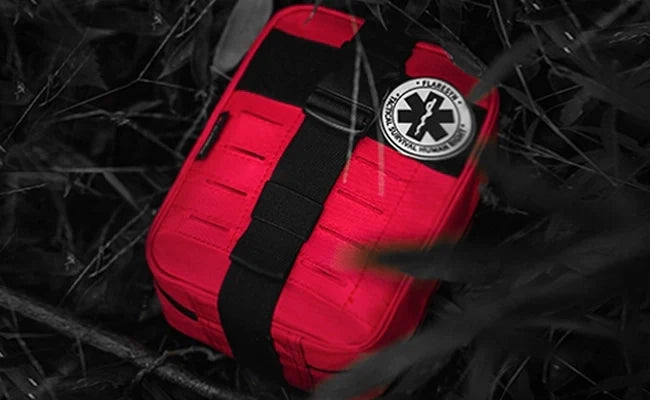
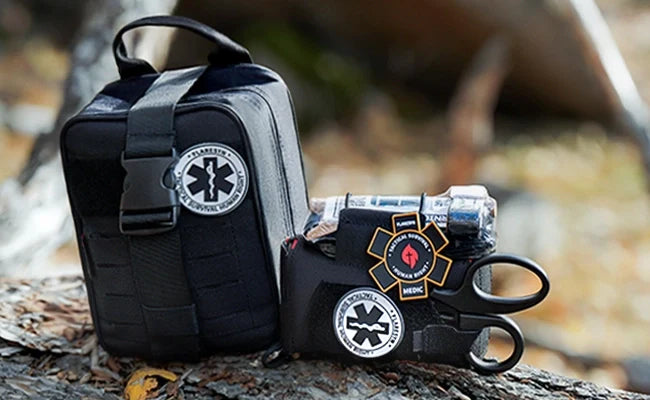
A professional personal injury kit—often called an Individual First Aid Kit (IFAK)—should be packed chronologically according to the MARCH sequence. When you open a FlareSyn IFAK, the first things your eyes and hands should lock onto are the tools for the "M" phase.
The FlareSyn Tactical Tourniquet belongs in an exterior pouch or at the very top of the opening insert, instantly ready for one-handed deployment. Directly beneath it should sit your Chitosan Hemostatic Gauze. As you work your way deeper into the kit, you transition to the "A & R" components: the Vented Chest Seals. At the bottom or back of the insert lies your Thermal Mylar Blanket for the "H" phase. This top-down, phased organization ensures that you never have to search for what you need next; the bag dictates the rhythm of the rescue.
Reducing Cognitive Load: Intuitive System Design
When adrenaline dumps into your bloodstream, your fine motor skills degrade, and your brain struggles with complex choices. This is the reasoning behind FlareSyn’s intuitive, high-visibility interior layout.
By using clear modular compartments and high-contrast pull tabs, our kits remove the guesswork from trauma care. You don't have to think about which bandage is which under a flashlight in the rain. The clear visual layout acts as a secondary brain, ensuring that even a civilian with minimal field experience can execute the MARCH protocol flawlessly.
From Theory to Muscle Memory
The ultimate truth of emergency medicine is that gear without training is just a false sense of security. We highly recommend establishing a routine of "dry-run" training. Practice pulling your FlareSyn tourniquet with your non-dominant hand. Practice opening a chest seal package with gloves on. By pairing FlareSyn's precision-engineered gear with the structured workflow of the MARCH Protocol, you turn technical medical theory into fluid muscle memory. When the crisis arrives, you won't need to remember what to do—your training and your kit will do it for you.
At its core, the MARCH Protocol is a tool that democratizes life-saving competence. It strips away the intimidating complexity of emergency medicine and replaces it with a reliable, step-by-step architecture for survival. You do not need a medical degree to save a life in the field; you need a system that works under pressure and the conviction to execute it. By breaking the chaos of trauma down into manageable phases—from the critical first 60 seconds of massive hemorrhage to the quiet danger of hypothermia—MARCH ensures you always have a path forward.
But a protocol is only as reliable as the tools used to enforce it. When the universe forces you into a "Zero-Second" reality, the quality of your equipment dictates your ceiling of success. Do not compromise with replicas or unverified gear. Equip your home, your vehicle, and your pack with an ecosystem engineered to endure the worst day of your life.
Equip the system, master the protocol. Complete your MARCH-ready kit with FlareSyn today.
Q: Do I need prior medical training to use the MARCH protocol?
A: Absolutely not. The beauty of the MARCH protocol is that it was explicitly designed for non-medical personnel (like soldiers and civilian bystanders) operating under intense stress. It strips away complex clinical diagnoses and replaces them with an intuitive, "if-this-then-that" sequence. If you can follow a checklist, you can execute the MARCH protocol.
Q: Can I use the FlareSyn Tourniquet and Chitosan Gauze on children?
A: Yes, with minor adjustments. For young children or toddlers whose limbs are too small for a standard windlass tourniquet to achieve compression, wound packing with FlareSyn Chitosan Hemostatic Gauze paired with continuous direct pressure is the gold standard. For older children, a standard tourniquet can be used effectively as long as it can be tightened securely above the wound.
Q: If the bleeding stops during the "M" phase, do I still need to do the rest of MARCH?
A: Yes, without exception. This is a critical error many civilian responders make. Stopping the external blood loss is only the first step. A patient can still die from a hidden tension pneumothorax (R phase) or lapse into fatal metabolic shock due to hypothermia (H phase). You must always complete the protocol from M to H to ensure all life threats are stabilized.
Q: How often should I check or re-organize my MARCH-aligned IFAK?
A: We recommend auditing your trauma kit at least twice a year. Check the expiration dates on your Chitosan gauze and chest seals (as seals can lose adhesion over time in extreme temperature fluctuations, such as inside a vehicle glove box). Use this audit as an opportunity to physically trace your hand through the bag to reinforce your visual muscle memory of the MARCH layout.


Elias.H.Hwang
Elias H. Hwang is a tactical medicine expert and lead contributor at FlareSyn. He specializes in emergency trauma protocols and preparedness education, helping civilians and professionals alike master the tools and skills needed to save lives in critical moments.
%20%7C%20%F0%9F%94%AC%20Medically%20Reviewed%20by:%20Dr.%20Alan%20Hastings,%20TCCC%20Certified%20Instructor%20/%20Paramedic%20Expert%20on%20April%2027,%202026.%0A%0A%20%20%20%20%0A%20%20%20%20%0A%20%20%20%20%0A%20%20%20%20%0A%20%20%20%20%20%20%0A%0A%20%20%20%20...)
Hinterlasse einen Kommentar
Diese Website ist durch hCaptcha geschützt und es gelten die allgemeinen Geschäftsbedingungen und Datenschutzbestimmungen von hCaptcha.