

Arterial vs Venous Bleeding: Identify and Respond Fast
Bleeding injuries often look similar at first glance, but the source of blood loss changes how dangerous the situation is. In emergency care, seconds matter. A person can lose a life-threatening amount of blood within minutes if the bleeding is not controlled properly. This is why identifying whether the bleeding comes from an artery or a vein is one of the first steps in trauma response.
Arterial bleeding usually involves fast blood loss due to high pressure inside the arteries. Venous bleeding is slower but still serious if a large vein is damaged. Correct identification helps decide the right first aid steps, such as direct pressure, wound packing, or using a tourniquet in severe cases. In the United States, emergency medical services emphasize early recognition because it directly affects survival rates in trauma cases such as road accidents, workplace injuries, or deep cuts.
Human Circulatory System Context for Bleeding Classification
To understand bleeding types, it is important to understand how blood moves in the body. The circulatory system is made of three main types of blood vessels, each with a different role.
Blood Vessel Architecture in the Body
-
Arteries: Carry oxygen-rich blood away from the heart under high pressure
-
Veins: Return oxygen-poor blood to the heart under lower pressure
-
Capillaries: Tiny vessels where oxygen and nutrients are exchanged in tissues
Arteries are thick and muscular because they handle strong pressure from the heart. Veins are thinner and rely on muscle movement and valves to push blood upward. Capillaries are extremely small and fragile, which is why minor skin injuries often cause surface bleeding.
Oxygenated vs Deoxygenated Blood Flow
Blood color differences in bleeding come from oxygen levels:
- Oxygen-rich blood appears brighter red
- Oxygen-poor blood appears darker red
Arterial bleeding is usually bright red due to oxygen content, while venous bleeding looks darker because it carries blood returning to the lungs for oxygen refill.
Blood Pressure Differences and Clinical Impact
Pressure inside blood vessels plays a major role in bleeding severity.
|
Vessel Type |
Blood Pressure |
Flow Pattern |
Bleeding Risk |
|
Arteries |
High |
Pulsing / spurting |
Very high |
|
Veins |
Low |
Steady flow |
Moderate |
|
Capillaries |
Very low |
Oozing |
Low |
High arterial pressure explains why even a small arterial injury can cause rapid blood loss.
Arterial Bleeding: Pathophysiology and Emergency Severity
Arterial bleeding is one of the most serious types of external bleeding. It occurs when an artery is cut or torn, allowing blood to escape under strong pressure from the heart’s pumping action.
Arterial bleeding happens when the arterial wall is damaged. Because arteries are under constant pressure, blood is forced out in rhythmic bursts that match the heartbeat. This makes blood loss faster compared to other bleeding types.
Common Trauma Causes
Arterial injuries often result from high-impact events such as:
- Deep penetrating wounds
- Gunshot injuries
- Severe cuts from sharp tools or machinery
- Road traffic collisions
- Industrial accidents
These injuries are commonly seen in emergency rooms across the United States, especially in construction and transport-related incidents.
Clinical Presentation and Diagnostic Signs
Key signs of arterial bleeding include:
- Bright red blood
- Spurting or pulsing flow
- Rapid soaking of cloth or bandages
- Difficulty stopping bleeding with light pressure
The pulsing pattern is a strong indicator that an artery has been damaged.
Immediate Physiological Risks
Arterial bleeding can become life-threatening quickly. The body loses oxygen-rich blood, which affects brain and organ function. Possible outcomes include:
- Rapid drop in blood pressure
- Dizziness and confusion
- Loss of consciousness
- Shock due to blood loss
Without fast intervention, severe arterial bleeding can become fatal in a short time.
Venous Bleeding: Clinical Characteristics and Risk Profile
Venous bleeding occurs when a vein is injured. While it is generally less intense than arterial bleeding, it still requires proper attention, especially if a large vein is involved. In venous bleeding, blood flows under lower pressure. This results in a steady, continuous flow instead of pulsing bursts. Because veins are closer to the surface in many areas of the body, cuts can easily damage them.
Common Injury Mechanisms
Venous bleeding is commonly caused by:
- Deep cuts and lacerations
- Surgical incisions
- Varicose vein rupture
- Blunt trauma injuries
Such injuries are frequently seen in emergency departments, especially from household accidents and minor vehicle crashes.
Observable Clinical Signs
Venous bleeding usually shows:
- Dark red blood
- Steady flow without pulsing
- Slower blood loss compared to arteries
- Easier control with pressure
Complication Potential
Even though venous bleeding is less forceful, risks still exist:
- Excessive blood loss if not treated
- Infection in open wounds
- Delayed healing in deep cuts
- Risk increases in patients with clotting disorders
Capillary Bleeding and Minor Vascular Injuries
Capillary bleeding is the most common and least dangerous type of bleeding. It happens when the tiny blood vessels near the skin surface are damaged. These vessels are responsible for small-scale blood exchange between tissues and the bloodstream.
This type of bleeding is often seen in everyday injuries such as scrapes, minor cuts, and abrasions. The blood usually oozes slowly instead of flowing or spurting. Because capillaries are very small, the body can usually stop this type of bleeding on its own within a few minutes through natural clotting.
Even though capillary bleeding is mild, proper cleaning is still important. If dirt or bacteria enter the wound, it can lead to infection. In emergency care settings in the United States, even minor wounds are cleaned and covered to reduce infection risk and promote faster healing.
Arterial vs Venous Bleeding: Clinical Comparison Framework
Understanding the difference between arterial and venous bleeding becomes much clearer when it is broken down into how the body’s blood flow behaves under injury conditions. In emergency medicine, this comparison helps responders quickly judge how serious a wound is and what action should be taken first. The goal is not just identification, but fast decision-making that reduces blood loss and improves survival outcomes.
Hemodynamic Differences (Pressure & Flow Behavior)
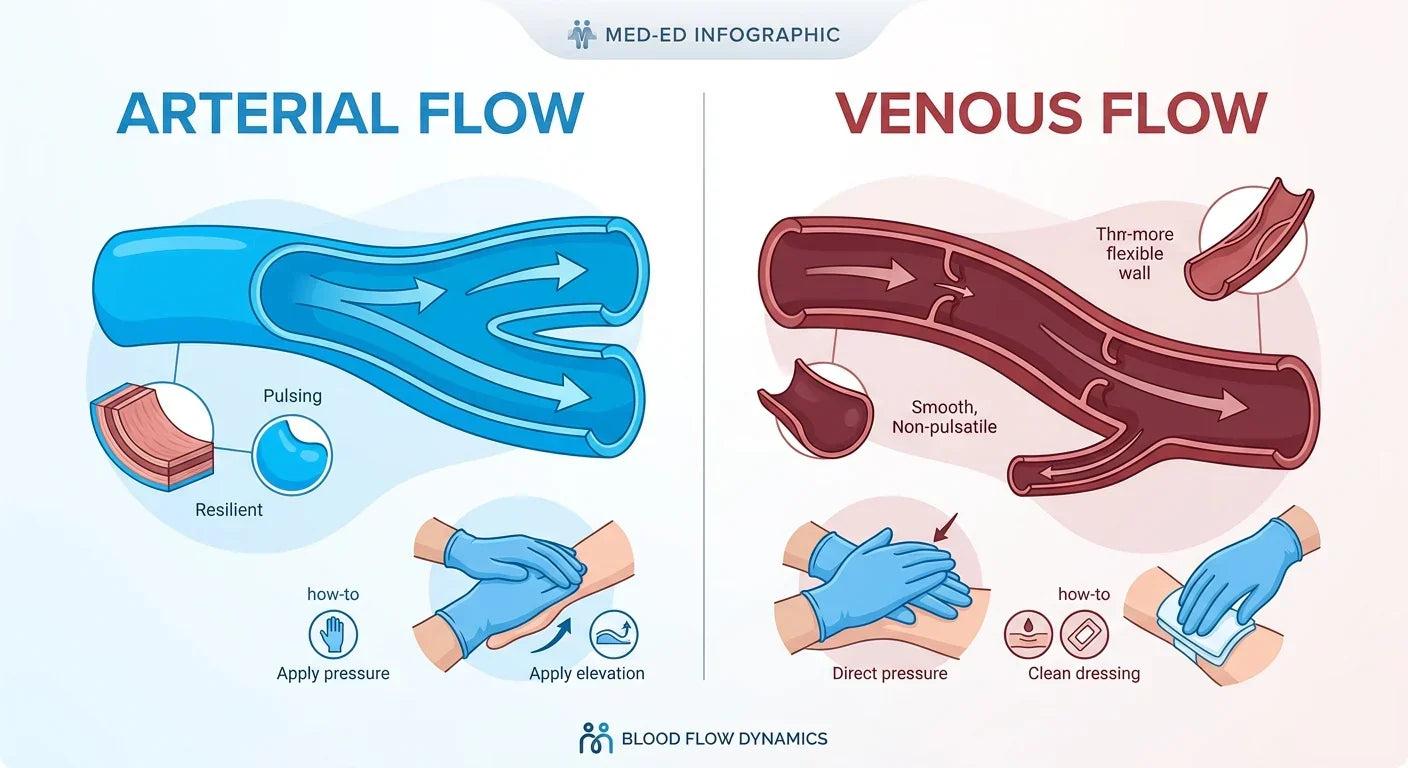
Hemodynamics refers to how blood moves through the vessels, and this is the main reason arterial and venous bleeding behave differently. Arterial blood flows under high pressure because it is directly pumped from the heart. When an artery is damaged, this pressure forces blood out in strong, rhythmic spurts that often match the heartbeat.
Venous blood moves under much lower pressure because veins return blood to the heart rather than receiving it directly from the pump. As a result, venous bleeding is usually steady and continuous without pulsing. This difference in pressure is the key factor that determines how fast blood is lost and how urgently treatment is needed.
Visual Diagnostic Indicators
Visual cues are often the fastest way to identify the type of bleeding in real-life emergencies. Arterial bleeding is typically bright red due to higher oxygen content and is often seen spurting or jetting from the wound. This pattern becomes more noticeable when the heart beats, making the bleeding appear rhythmic.
Venous bleeding, in contrast, usually appears darker red or maroon. The flow is smooth and consistent rather than forceful. In many cases, venous bleeding spreads across the wound area or pools steadily instead of spraying outward. These visual differences are critical in situations where quick judgment is needed before advanced medical help arrives.
Severity Classification in Emergency Medicine
In clinical and emergency care settings, bleeding is classified based on how quickly it can lead to life-threatening blood loss. Arterial bleeding is considered high severity because even small arterial injuries can lead to rapid volume loss and early onset of shock.
Venous bleeding is generally classified as moderate severity, but it can escalate if a major vein is damaged or if the bleeding is not controlled. Medical teams also consider factors such as wound depth, location, and patient condition when assessing severity. For example, venous bleeding from large veins in the neck or thighs can still become critical if untreated.
Response Priority in Trauma Care
Emergency response prioritizes bleeding control based on how quickly a patient can deteriorate. Arterial bleeding is always treated as an immediate life threat and requires instant intervention, often starting with direct pressure and progressing to advanced methods like tourniquet application if needed.
Venous bleeding is still treated urgently but usually allows slightly more time for controlled management. First responders focus on applying direct pressure, elevating the wound if possible, and dressing it securely. In both cases, rapid activation of emergency medical services (EMS) is essential, especially when blood loss is significant or the source is unclear.
Trauma-Based Causes of Severe Bleeding
Severe bleeding injuries are usually linked to trauma. In the United States, emergency departments frequently treat bleeding caused by accidents, workplace injuries, and high-impact events.
Common causes include blunt force trauma from falls or collisions, penetrating injuries such as knife wounds, and industrial accidents involving sharp tools or machinery. Road traffic accidents remain one of the leading causes of both arterial and venous bleeding cases.
Gunshot wounds and deep stab injuries can damage multiple blood vessels at once, leading to mixed bleeding patterns. In such cases, identifying the primary source of bleeding becomes more difficult, which is why emergency responders focus first on controlling blood loss rather than classification.
Emergency Hemorrhage Control: First Aid Protocols
Controlling bleeding quickly is the most important step in emergency care. The goal is to reduce blood loss until professional medical help arrives.
Direct pressure is the first and most effective method. Applying firm pressure on the wound helps slow or stop blood flow by allowing clot formation. Clean cloth or sterile dressings are commonly used for this purpose.
For deeper wounds, wound packing may be required. This involves placing gauze or clean material inside the wound to absorb blood and apply internal pressure. Compression bandages are then used to maintain steady pressure.
Sterile dressing is important to reduce infection risk, especially in open wounds exposed to dirt or debris. In all cases, maintaining pressure without repeatedly checking the wound is key, as disturbing clots can restart bleeding.
Advanced Bleeding Control Techniques in Severe Cases
In cases of severe arterial bleeding, basic pressure may not be enough. This is where advanced emergency techniques are used.
A tourniquet may be applied to restrict blood flow to a limb when bleeding cannot be controlled otherwise. It is a critical tool in trauma care but must be used carefully to avoid tissue damage if left on too long.
Hemostatic gauze is another advanced option used in emergency medicine. It contains agents that help blood clot faster, making it effective in deep or severe wounds.
In the United States, emergency responders follow strict protocols in first aid for bleeding, where uncontrolled bleeding is treated as a priority before any other injury. CPR may also be required if blood loss leads to cardiac arrest.
Emergency medical services (EMS) play a vital role here. Calling EMS early ensures that trained professionals can take over care quickly and reduce complications.
Life-Threatening Complications of Uncontrolled Bleeding
If bleeding is not controlled in time, it can lead to serious medical complications. The most immediate risk is hypovolemic shock, a condition where the body loses too much blood and cannot maintain normal circulation.
When blood volume drops, organs do not receive enough oxygen. This can lead to dizziness, confusion, cold skin, and eventually unconsciousness. Without treatment, it can progress to complete circulatory failure.
Another major risk is tissue damage. When oxygen supply is reduced, cells begin to die, which may lead to necrosis in severe cases. Open wounds also carry a risk of infection, especially if exposed to environmental bacteria.
Internal vs External Bleeding Assessment
External bleeding is visible and easier to identify, while internal bleeding is hidden and more dangerous in many cases. Internal bleeding may occur after trauma even when there is no visible wound. Signs of internal bleeding include abdominal pain, swelling, bruising, dizziness, and weakness. In some cases, internal arterial damage can lead to rapid blood loss inside the body without external signs. This makes medical evaluation critical after serious injuries, even if external bleeding appears minor or controlled. At FlareSyn, we provide practical guidance on emergency care topics to help you respond confidently in critical situations.
High-Risk Vascular Conditions Linked to Bleeding Disorders
Certain medical conditions can increase the risk of abnormal bleeding. Venous insufficiency, for example, affects how blood returns to the heart and can lead to swelling and vein damage. Deep vein thrombosis (DVT) involves blood clots forming in deep veins, which can become life-threatening if they travel to the lungs and cause pulmonary embolism.
These conditions are important in clinical settings because they can worsen bleeding outcomes or create complications during injury recovery.
First Aid Training and Certification Importance
First aid training plays a major role in improving survival rates in bleeding emergencies. People trained in Basic Life Support (BLS training) and CPR certification are better prepared to respond quickly and correctly.
Training also covers the use of AED devices, wound care techniques, bleeding control essentials, and methods such as pressure application and tourniquet use.
In workplace environments across the United States, certified training is often required to meet safety standards and reduce injury-related fatalities.
In serious bleeding situations, professional emergency care systems provide critical support. Trained medical teams follow structured protocols to stabilize patients and prevent complications.
For organizations and workplaces, access to certified first aid training and emergency preparedness programs improves overall safety. Services like these help teams respond faster and reduce risk during medical emergencies.
Arterial and venous bleeding differ mainly in pressure, flow pattern, and severity. Arterial bleeding requires immediate emergency action due to rapid blood loss, while venous bleeding allows slightly more controlled intervention. Understanding these differences helps in making fast decisions that can save lives in trauma situations.


