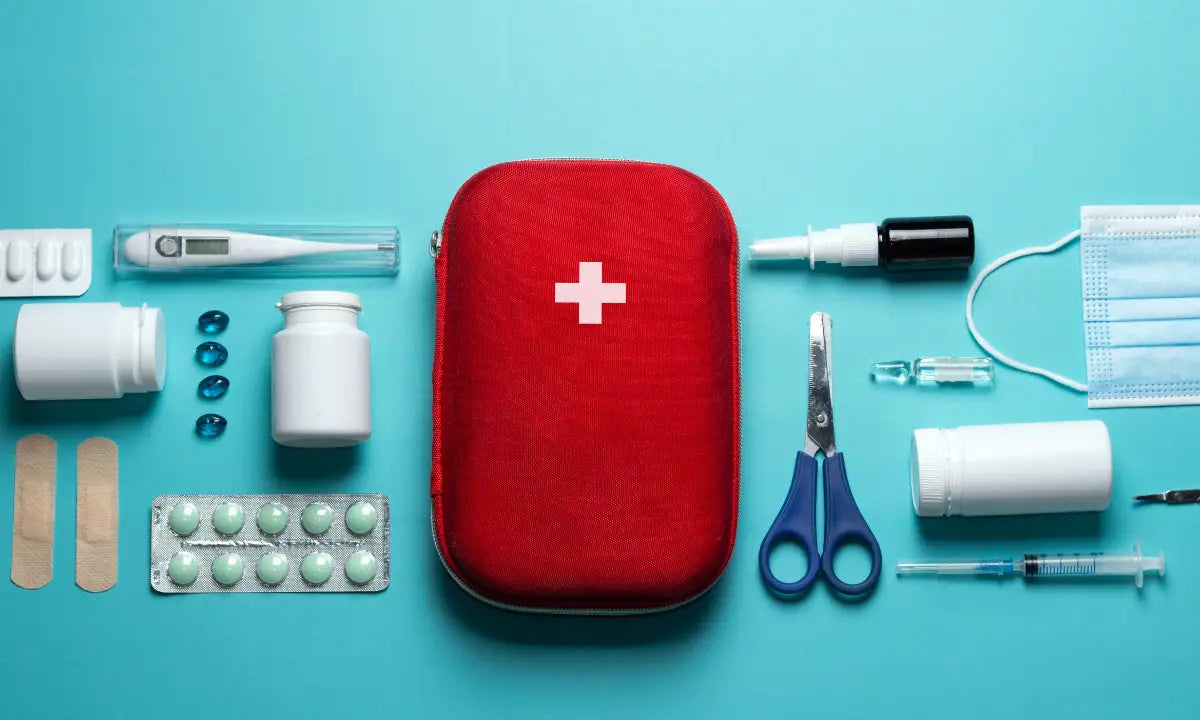
Emergency First Aid Tips: What to Do Before Help Arrives
Reviewed and Updated: July 18, 2026
Someone has collapsed, suffered a deep bleeding injury, or suddenly cannot breathe. In that moment, the hardest question is often the simplest: What should you do first? The safest response is to check that the area is safe, assess whether the person responds and breathes normally, contact emergency services, and begin care for the most immediate threat to life. These emergency first aid tips explain that process in clear steps so you can act without wasting critical time while professional help is on the way.
Important: Call 911 in the United States or your local emergency number during a life-threatening emergency. Put the phone on speaker and follow the dispatcher’s instructions. This guide is for education and preparation. It does not replace certified first-aid training, product instructions, or professional medical care.
Emergency First Aid Tips: What Should You Do First?
The first few actions should follow one clear order: Check, Call, and Care. Check the scene and the person, call emergency services when a serious condition is present, and provide care based on what you find. Do not spend several minutes gathering a full medical history while the person is not breathing or losing blood. Focus first on dangers that can cause death within minutes, including cardiac arrest, airway obstruction, and life-threatening bleeding.
Make Sure the Scene Is Safe
Before touching the injured or ill person, look for hazards that could harm you, the person, or anyone nearby. A responder who runs into traffic, enters a smoke-filled room, touches an active electrical source, or approaches an ongoing violent incident may become another casualty. Scene safety does not mean standing back when help is possible. It means identifying danger quickly and taking action from a safer position.
Common hazards include:
- Moving vehicles
- Fire, smoke, or leaking fuel
- Exposed electrical wires
- Chemical spills or fumes
- Deep or moving water
- Unstable structures
- Weapons or continuing violence
- Broken glass and sharp metal
- Blood and other body fluids
Wear nitrile gloves when available. Eye protection may also be useful when blood could splash. If the scene remains unsafe, call emergency services and wait for trained responders with the proper equipment.
Check Responsiveness and Normal Breathing
Speak loudly to the person and ask whether they are okay. If there is no answer, tap an adult or child on the shoulder and call to them again. Check for normal breathing while looking for severe bleeding or another obvious emergency. Complete this check within 10 seconds.
Occasional gasping, snorting, or irregular breaths should not be mistaken for normal breathing. A person in cardiac arrest may gasp even though the heart is no longer pumping blood effectively. If the person is unresponsive and is not breathing normally or is only gasping, call 911, obtain an automated external defibrillator, and begin cardiopulmonary resuscitation.
Call Emergency Services and Get Equipment
Call 911 immediately when a person is unresponsive, is not breathing normally, has life-threatening bleeding, is severely choking, or shows signs of another serious medical emergency. Use speakerphone so you can begin care while answering the dispatcher’s questions.
Tell the dispatcher:
- Your exact location
- What happened
- How many people are injured or ill
- Whether the person is responsive
- Whether the person is breathing normally
- Whether severe bleeding is present
- What first aid has already been given
If other people are nearby, assign specific tasks. Tell one person to call 911, another to bring an AED, and another to retrieve the first aid or trauma kit. Saying “someone call for help” may lead everyone to assume another person is doing it.
Give Care for the Condition Found
Once emergency services have been contacted, treat the immediate threat within your level of training. An unresponsive person who is not breathing normally needs CPR and an AED. Severe external bleeding needs pressure, wound packing, or a suitable tourniquet. A severely choking person needs choking care. An unresponsive person who is breathing normally may need the recovery position.
Continue watching the person’s breathing and responsiveness because their condition may change. Stay with them until emergency medical services take over.
|
Step |
What to Do |
Why It Matters |
|
Check |
Confirm scene safety and assess responsiveness, breathing, and severe bleeding |
Identifies immediate threats without creating another casualty |
|
Call |
Contact 911 and obtain an AED or trauma equipment |
Starts professional medical response |
|
Care |
Give CPR, control bleeding, provide choking care, or protect the airway |
Supports life until responders arrive |
|
Monitor |
Recheck breathing, responsiveness, and bleeding |
The person’s condition may worsen quickly |
|
Handover |
Explain what happened and what care was given |
Helps EMS continue treatment efficiently |
How to Prioritize Different Life-Threatening Emergencies
A real emergency may involve more than one injury. A person in a vehicle collision, for example, could be unresponsive and bleeding at the same time. Your priority depends on what you find during the first 10-second assessment. If several trained people are present, tasks can happen at the same time: one person can call 911, one can begin CPR, and another can control bleeding.
|
What You Find |
Immediate Priority |
|
Unresponsive and not breathing normally |
Call 911, begin CPR, and use an AED |
|
Heavy external bleeding |
Apply immediate bleeding control |
|
Unable to speak, breathe, or cough effectively |
Begin age-appropriate choking care |
|
Unresponsive but breathing normally |
Protect the airway and monitor breathing |
|
Responsive but seriously ill or injured |
Keep the person safe, call for help, and monitor them |
Do not delay urgent care while trying to identify the exact diagnosis. A lay responder does not need to determine the precise cause of cardiac arrest before starting CPR or identify the damaged blood vessel before applying direct pressure.
Perform CPR and Use an AED During Cardiac Arrest
Cardiac arrest occurs when the heart stops or beats too ineffectively to circulate blood to the brain and other organs. The person becomes unresponsive and stops breathing normally, although gasping may occur. Immediate CPR helps move some oxygenated blood through the body, while an AED can analyze the heart rhythm and deliver a shock when needed.
How to Recognize Possible Cardiac Arrest
Suspect cardiac arrest when an adult suddenly collapses, does not respond when spoken to or tapped, and is not breathing normally. Do not delay CPR by searching for a pulse if you are not trained to check one accurately. The public first-aid response is based on responsiveness and breathing.
Warning signs include:
- Sudden collapse
- No response to voice or touch
- No normal breathing
- Only gasping or irregular breaths
- Pale, gray, or bluish skin
If the person responds or breathes normally, they are not currently in cardiac arrest, but they may still need urgent medical care.
Hands-Only CPR for an Adult
Hands-only CPR is appropriate for an untrained bystander helping an adult or teenager who suddenly collapses. Trained rescuers may provide conventional CPR with breaths according to their certification. The key is to begin compressions quickly instead of doing nothing because you are worried about making a mistake.
To provide hands-only CPR:
- Place the person on their back on a firm, flat surface.
- Kneel beside the chest.
- Put the heel of one hand in the center of the chest.
- Place the other hand on top and interlock your fingers.
- Keep your shoulders directly over your hands and your elbows straight.
- Push hard and fast at a rate of 100 to 120 compressions per minute.
- Compress the adult chest at least 2 inches and allow it to return fully after each compression.
- Continue until an AED is ready, the person shows clear signs of life, trained responders take over, the scene becomes unsafe, or you are physically unable to continue.
The Red Cross advises keeping interruptions in compressions under 10 seconds and using an AED as soon as one becomes available.
How to Use an AED
An automated external defibrillator is built to guide the user with pictures and voice prompts. It analyzes the heart rhythm and will advise a shock only when its programmed criteria identify a shockable rhythm. Do not wait for a healthcare professional to arrive if an AED is available.
Use it as follows:
- Turn on the AED.
- Expose the person’s chest.
- Dry the chest if it is wet.
- Attach the pads in the positions shown on the diagrams.
- Connect the pad cable if the unit requires it.
- Keep everyone clear while the AED analyzes the rhythm.
- Deliver the shock if instructed.
- Resume CPR immediately after the shock or when the device tells you no shock is advised.
- Continue following the voice prompts.
Do not touch the person during rhythm analysis or shock delivery.
Adult, Child, and Infant CPR Are Different
The basic goal remains the same for every age: circulate oxygenated blood until the heart can pump effectively again. However, hand placement, compression depth, the number of hands or fingers used, and the role of rescue breaths differ for adults, children, and infants.
Parents, teachers, coaches, and caregivers should complete pediatric CPR training rather than relying on adult instructions during a child or infant emergency. Drowning, choking, and many pediatric cardiac arrests begin with a breathing problem, so rescue breaths may be especially important when the responder is trained.
Heart Attack vs. Cardiac Arrest
A heart attack and cardiac arrest are separate conditions. A heart attack occurs when blood supply to part of the heart muscle is blocked. The person is often awake and breathing. Cardiac arrest occurs when the heart stops pumping effectively, causing the person to become unresponsive and stop breathing normally. A heart attack can lead to cardiac arrest, but many people experiencing a heart attack do not immediately lose consciousness.
|
Heart Attack |
Cardiac Arrest |
|
Blood flow to part of the heart is blocked |
The heart stops pumping effectively |
|
The person is often awake |
The person is unresponsive |
|
Breathing may continue |
Normal breathing is absent |
|
Call 911 and keep the person at rest |
Call 911, start CPR, and use an AED |
|
Monitor closely in case cardiac arrest occurs |
Continue CPR and AED care until help takes over |
Control Life-Threatening External Bleeding
Severe blood loss can become fatal before an ambulance arrives, so bleeding control should begin as soon as the wound is identified. The main public bleeding-control methods are firm direct pressure, wound packing, and tourniquet use for appropriate arm or leg injuries.

How to Recognize Life-Threatening Bleeding
Do not judge severity only by the size of the skin opening. A small penetrating wound may damage a major blood vessel beneath the surface, while a wide but shallow cut may bleed less heavily.
Treat bleeding as life-threatening when you see:
- Blood flowing continuously
- Blood spurting from the wound
- A pool of blood forming
- Clothing rapidly becoming soaked
- A partial or complete amputation
- Bleeding that continues despite pressure
- Pale, gray, cool, or clammy skin
- Weakness, confusion, restlessness, or reduced responsiveness
The Red Cross lists continuous or spurting blood and signs of shock as reasons for immediate emergency treatment.
Apply Firm Direct Pressure
Expose the injury enough to find the actual source of bleeding. Place gauze, a hemostatic dressing, or another clean material directly over the wound and press firmly with both hands when possible. Keep the injured area supported on a firm surface.
Pressure must be steady and focused. Lightly resting several pads over a wound may absorb blood without compressing the damaged vessel. Hold pressure until the bleeding stops, another trained responder takes over, a tourniquet is applied to a suitable limb injury, or the situation becomes unsafe.
Do not repeatedly lift the original dressing to check the wound. Disturbing it can break the developing clot. If blood comes through, keep the original dressing against the wound and maintain firm manual pressure.
Pack an Appropriate Deep Wound
Wound packing is used for deep, compressible wounds where pressure over the skin surface may not reach the bleeding vessel. The goal is to place gauze firmly against the source of bleeding and fill the wound cavity so pressure reaches the damaged tissue.
The general process is:
- Expose the injury.
- Identify where the blood is coming from.
- Place the end of the gauze directly against that point.
- Pack the material firmly into the wound while maintaining pressure.
- Continue until the cavity is filled.
- Apply strong direct pressure according to your training and the product instructions.
- Secure the packed wound with a pressure dressing when bleeding is controlled.
Wound packing may be used by trained responders for suitable injuries involving areas such as the shoulder, groin, neck, scalp, back, or a limb when no tourniquet is available. It should not be treated as a universal method for every chest, abdominal, or eye injury.
Choose Between Hemostatic and Traditional Gauze
Traditional gauze controls bleeding by filling the wound and creating mechanical pressure. Hemostatic gauze combines that structure with a material such as chitosan or kaolin that supports local bleeding control. The U.S. Food and Drug Administration notes that topical hemostatic dressings may combine gauze with chitosan, kaolin, or other hemostatic materials, and that these products are intended for temporary bleeding control rather than permanent implantation.
Chitosan gauze can form an adhesive, gel-like physical barrier when it contacts blood, but it still needs direct contact with the wound and firm pressure. Traditional compressed gauze remains useful when hemostatic gauze is unavailable and can be effective when it is packed correctly.
Neither option replaces technique. Advanced gauze left loosely on top of a deep wound may fail, while traditional gauze packed firmly against the bleeding source may control significant blood loss.
Use a Tourniquet for Suitable Limb Bleeding
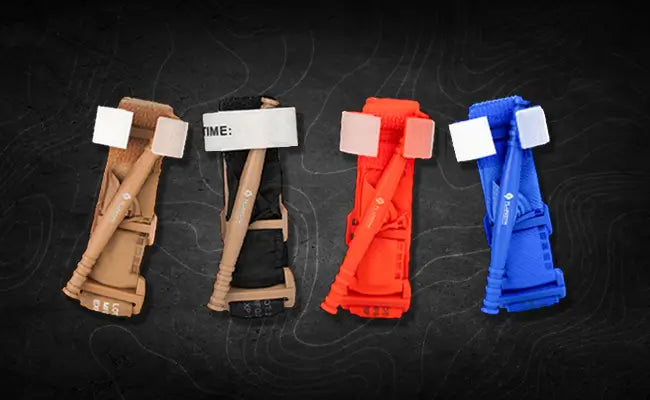
A tourniquet may be needed for life-threatening bleeding from an arm or leg, especially when pressure is ineffective, cannot be maintained, or the injury involves an amputation. Use a device intended for severe extremity bleeding and follow the instructions provided with it.
General safety points include:
- Place the tourniquet above the wound and not directly over a joint.
- Tighten it until severe bleeding stops.
- Record the application time when possible.
- Do not cover it with clothing or bandages.
- Do not loosen or remove it because the person reports pain.
- Leave management of the applied tourniquet to emergency professionals unless your formal protocol says otherwise.
A standard limb tourniquet should never be placed around the neck, chest, or abdomen. Stop the Bleed teaches tourniquet use for severe extremity bleeding as part of a broader response that includes pressure and wound packing.
Avoid These Severe-Bleeding Mistakes
Small errors can prevent pressure from reaching the bleeding vessel. The most common problems involve delay, poor placement, and repeatedly disturbing the wound.
Avoid:
- Waiting to call emergency services
- Pressing beside the wound instead of over the source
- Packing gauze loosely
- Removing the original dressing repeatedly
- Pulling out an embedded object
- Applying a tourniquet over a joint
- Assuming hemostatic gauze works without pressure
- Loosening a tourniquet after it has stopped the bleeding
- Giving the injured person food or drink
- Allowing the person to become cold
If an object is embedded in the wound, do not remove it. Apply pressure around it and stabilize it with bulky dressings. Removing the object may increase bleeding.
Care for an Unresponsive Person Who Is Breathing
An unresponsive person who is breathing normally does not need chest compressions at that moment, but they still face a serious risk. The tongue, vomit, blood, or relaxed tissues may obstruct the airway, and normal breathing may stop without warning.
Use the Recovery Position When Appropriate
Place the person on their side in the recovery position when there is no reason they must remain still. This helps keep the airway open and allows vomit, blood, or other fluid to drain from the mouth instead of moving into the lungs. Support the head and neck, position the face so fluid can drain, and bend a knee to stabilize the body. Stay beside the person and continue checking breathing.
When Movement May Be Unsafe
Avoid unnecessary movement when you suspect an injury to the head, neck, or back. Leave the person in the position found unless movement is required to escape danger, begin CPR, control severe bleeding, or protect the airway.
Possible signs of spinal injury include:
- Neck or back pain
- Weakness or numbness
- Loss of movement
- An unusual head or neck position
- A high-impact fall or collision
- A diving injury
- Reduced responsiveness after trauma
Do not ask a person with a possible spinal injury to stand, walk, or turn their head.
Continue Checking Breathing
Watch for chest movement and listen for changes in breathing. If breathing stops or becomes abnormal gasping, roll the person onto their back when safe and begin CPR. Keep them from becoming too cold or overheated and reassure them, even if they cannot answer.
Recognize and Manage Medical Shock
Medical shock is not the same as feeling frightened after an upsetting event. It is a life-threatening failure of circulation in which the organs do not receive enough oxygen-rich blood. Severe bleeding, anaphylaxis, major trauma, serious infection, and other medical conditions can cause shock.
Warning Signs of Shock
Shock may worsen even after visible bleeding appears controlled. Watch the whole person, not just the wound.
Signs may include:
- Rapid, weak heartbeat
- Fast breathing
- Pale, gray, cool, or moist skin
- Confusion or unusual irritability
- Restlessness
- Weakness or dizziness
- Nausea or vomiting
- Excessive thirst
- Reduced responsiveness
Any person showing these signs after a serious injury or illness needs immediate medical care.
Immediate Care While Help Is Coming
Treat the visible cause when possible, such as controlling external bleeding or helping with prescribed epinephrine during anaphylaxis. Keep the person in a safe and comfortable position and prevent heat loss with a blanket when needed. Do not automatically raise the legs when trauma, breathing difficulty, pain, or another condition makes that position unsafe. Do not give food or drink because the person may vomit or require an emergency procedure. Continue checking breathing and be ready to start CPR.
Actions That May Make Shock Worse
A person in shock needs calm, continuous observation. Avoid actions that increase physical stress or aspiration risk.
Do not:
- Make the person stand or walk
- Allow uncontrolled bleeding to continue
- Give food, water, alcohol, or medication by mouth
- Apply intense direct heat
- Leave the person alone
- Ignore a decline in alertness
- Assume the danger has passed because the wound looks better
Recognize Other Time-Critical Medical Emergencies
Many emergencies cannot be solved with a bandage or a single first-aid procedure. The responder’s main role is to recognize the warning signs, call for professional help quickly, keep the person safe, and monitor breathing and responsiveness.
Stroke
A stroke occurs when blood flow to part of the brain is blocked or bleeding occurs in the brain. Rapid treatment can reduce permanent disability, but the responder must recognize the signs and call 911 without delay.
Use FAST:
-
F — Face: Ask the person to smile. Look for drooping or uneven movement.
-
A — Arms: Ask them to raise both arms. Look for weakness or one arm drifting down.
-
S — Speech: Ask them to repeat a simple sentence. Listen for slurred, confused, or unusual speech.
-
T — Time: Call 911 immediately.
Note when the symptoms began or when the person was last known to be normal. Do not give food, drink, or medication unless directed by emergency professionals.
Heart Attack
A heart attack happens when blood flow to part of the heart muscle is blocked. Symptoms may be sudden or gradual and may not always include severe chest pain.
- Possible warning signs include:
- Pressure, squeezing, tightness, or discomfort in the chest
- Pain spreading to the arm, back, shoulder, neck, or jaw
- Shortness of breath
- Sweating
- Nausea or vomiting
- Dizziness
- Unusual fatigue
Call 911, keep the person at rest, obtain an AED, and monitor breathing. Do not drive the person to the hospital yourself when emergency medical services are available, because the condition may worsen during transport.
Anaphylaxis
Anaphylaxis is a severe allergic reaction that can quickly affect breathing and circulation. Common triggers include foods, insect stings, medications, and latex.
Warning signs may include:
- Swelling of the lips, tongue, face, or throat
- Difficulty breathing or swallowing
- Wheezing
- Widespread hives or skin redness
- Dizziness or fainting
Vomiting combined with breathing or circulation problems
- Sudden collapse
Help the person use their prescribed epinephrine device according to its instructions and your training. Call 911 even if symptoms improve, because they may return. Keep the person positioned comfortably and watch for shock or cardiac arrest.
Seizure
A seizure may cause uncontrolled movements, changes in awareness, unusual behavior, or a blank stare. During a convulsive seizure, focus on preventing injury rather than trying to stop the movements.
- Remember Stay, Safe, Side:
- Stay with the person and note how long the seizure lasts.
- Keep them safe by clearing hard or sharp objects.
- Turn them onto their side when safe to help protect the airway.
Do not restrain the person or place anything in their mouth. Call 911 if the seizure lasts longer than five minutes, repeats without recovery, occurs in water, causes injury or breathing difficulty, or is the person’s first known seizure.
|
Emergency |
Key Warning Signs |
Immediate Response |
Avoid |
|
Stroke |
Facial droop, arm weakness, speech difficulty |
Call 911 and note when symptoms began |
Food, drink, or waiting for symptoms to pass |
|
Heart attack |
Chest pressure, spreading pain, shortness of breath |
Call 911, keep at rest, get an AED |
Driving the person yourself when EMS is available |
|
Anaphylaxis |
Swelling, hives, wheezing, collapse |
Use prescribed epinephrine and call 911 |
Waiting to see whether severe symptoms improve |
|
Seizure |
Convulsions, loss of awareness, unusual movements |
Protect from injury, time the seizure, place on side when safe |
Restraint or objects in the mouth |
First Aid for Serious Injuries and Environmental Emergencies
Some emergencies need a short, specific response before professional care is available. The following table provides immediate actions, but the dispatcher’s instructions and certified training should take priority during a real incident.
|
Emergency |
Immediate First Aid |
What to Avoid |
|
Thermal burn |
Stop the burning process and cool with clean, cool running water |
Ice, butter, toothpaste, greasy creams, or adhesive dressings |
|
Suspected fracture |
Keep the injured area still and support it in the position found |
Forcing the bone or joint back into position |
|
Head or spinal injury |
Minimize movement and monitor breathing |
Making the person sit, stand, or walk |
|
Poison exposure |
Contact Poison Control or 911 based on symptoms |
Inducing vomiting unless specifically instructed |
|
Electrical injury |
Switch off the power before approaching and call for help |
Touching the person while the source is active |
|
Heatstroke |
Call 911 and begin rapid cooling |
Treating it as ordinary dehydration |
|
Hypothermia |
Move to shelter, remove wet clothing when possible, and warm gradually |
Rubbing the body or applying extreme direct heat |
|
Opioid overdose |
Call 911, give naloxone if available, and support breathing |
Leaving the person alone after they wake |
|
Nosebleed |
Sit forward and pinch the soft part of the nose |
Tilting the head backward |
For a thermal burn, the Red Cross recommends clean, cool running water for 5 to 20 minutes, removing jewelry or clothing that is not stuck, and loosely covering the injury with a clean non-adherent dressing when appropriate. Ice and greasy substances can worsen tissue damage.
For suspected poisoning in the United States, contact Poison Control at 1-800-222-1222 or use its official online service. Call 911 immediately if the person collapses, has a seizure, has trouble breathing, or cannot be awakened. Do not induce vomiting unless a poison specialist directs you to do so.
Naloxone can reverse an opioid overdose when given in time, but emergency help is still required even if the person wakes or improves. Call 911, give naloxone according to its instructions, support breathing within your training, and stay with the person.
Heatstroke is a life-threatening condition that needs rapid cooling while EMS is on the way. Hypothermia also requires urgent care; protect the person from further heat loss, remove saturated clothing when possible, and use blankets or other safe warming measures.
Build and Maintain an Emergency First Aid Kit
A useful emergency kit should match the injuries you may face and the places where care may be delayed. A standard first aid kit is useful for minor cuts, burns, and sprains, while a trauma kit focuses on severe bleeding and major injury. Many homes, vehicles, workplaces, range bags, and outdoor packs benefit from having access to both.
Essential First-Aid Supplies
A complete setup should include supplies for protection, routine injuries, bleeding control, and emergency support. The Red Cross recommends keeping a kit at home and in the car, checking it regularly, and replacing used or expired items.
Personal protection
- Nitrile gloves
- Eye protection
- CPR breathing barrier
Bleeding-control supplies
- Sterile gauze pads
- Compressed Z-fold gauze
- Hemostatic gauze
- Pressure dressing
- Suitable windlass tourniquet
- Trauma shears
- Medical tape
General injury supplies
- Adhesive bandages
- Non-adherent dressings
- Elastic wrap
- Burn dressing
- Instant cold pack
- Triangular bandage
- Splinting material
Emergency support
- Emergency blanket
- Permanent marker
- Flashlight
- Printed first-aid instructions
- Emergency contact information
- Personal medication and allergy details
Prepare for Severe Bleeding with FlareSyn
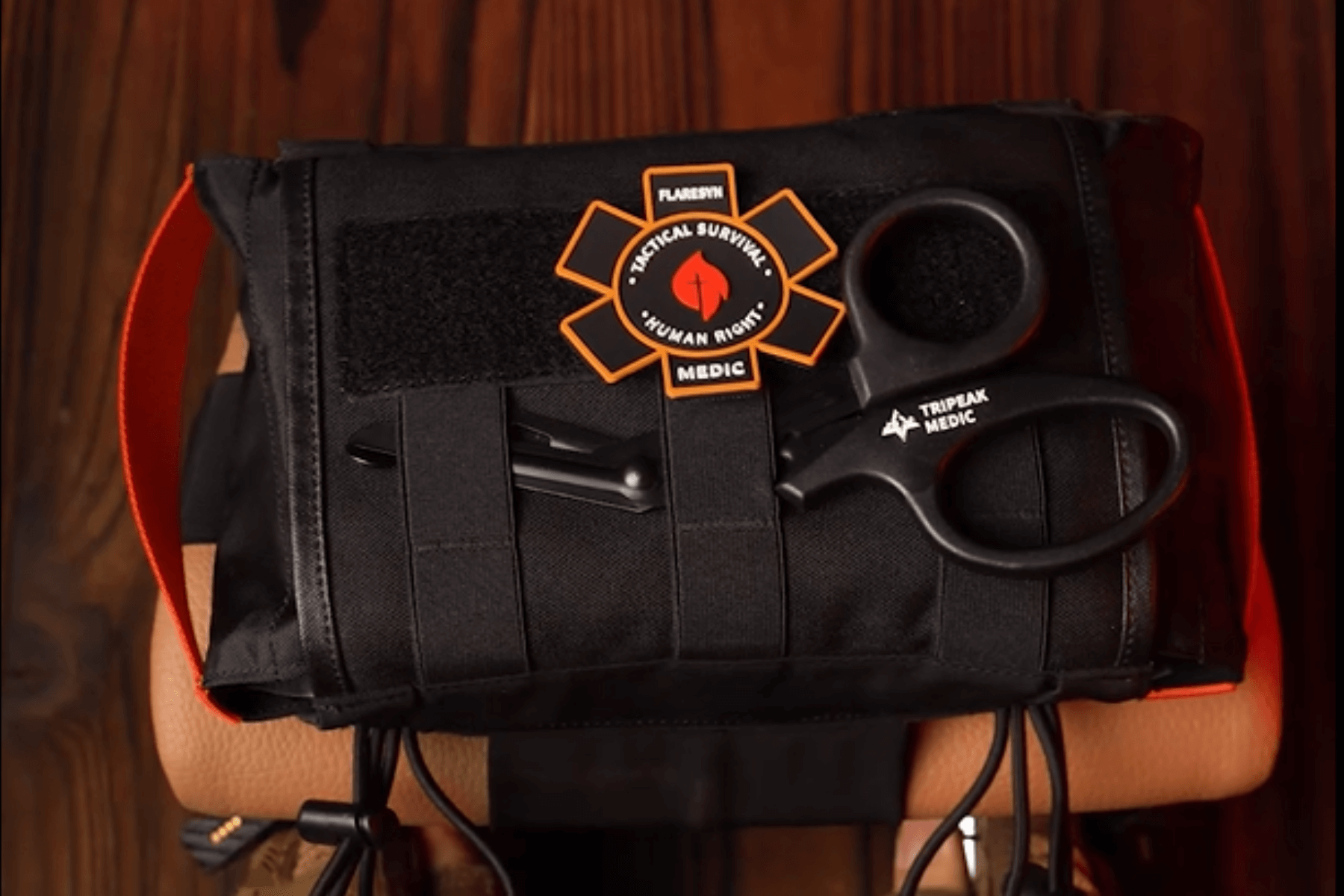
FlareSyn provides bleeding-control equipment and pre-filled trauma kits for home, vehicle, workplace, outdoor, range, patrol, and everyday-carry setups. Current product categories include chitosan hemostatic gauze, compressed gauze, pressure bandages, windlass tourniquets, refill components, compact IFAKs, and vehicle headrest trauma kits.
A practical FlareSyn setup may include:
- Chitosan hemostatic gauze for suitable severe, compressible wounds
- Traditional compressed gauze for wound packing and backup material
- A pressure dressing to maintain compression after initial control
- A windlass tourniquet for appropriate life-threatening arm or leg bleeding
- Trauma shears to expose an injury
- Nitrile gloves for personal protection
Choose equipment based on where it will be carried, the risks present, and the training of the people expected to use it. Read all instructions before placing a product in service, keep emergency items sealed until needed, and use separate training supplies for practice.
Prepare before the emergency begins. Explore FlareSyn’s bleeding-control products and build an organized kit for your home, vehicle, workplace, range bag, or outdoor equipment.
Final Takeaway
The most useful emergency first aid tips begin with a clear order: protect yourself, check the person, call for professional help, and treat the immediate threat. Start CPR when an unresponsive person is not breathing normally, control severe bleeding with pressure and the correct equipment, use age-appropriate care for choking, and protect the airway of an unresponsive person who is still breathing.
Preparation matters before the emergency starts. Keep an accessible first aid kit and trauma kit, inspect the supplies regularly, read product instructions, and complete hands-on training. The equipment in your home, vehicle, workplace, or outdoor bag is most valuable when you know where it is and how to use it.