Butterfly Bandage vs Steri Strip: Key Differences, Uses, and Safety Guide
A small cut can look simple at first, but the wrong closure choice can make healing harder. Many people reach for whatever is in the medicine cabinet, then wonder if a butterfly bandage is enough, if Steri-Strips would hold better, or if the cut actually needs stitches. That is exactly where confusion starts. A clean, shallow cut may only need careful cleaning, light closure support, and protection. A deeper, dirty, gaping, or bleeding wound needs a very different response. This guide breaks down the real difference between a butterfly bandage vs Steri Strip, when each one makes sense, and when you should stop trying to close the wound at home and get medical care.
Whether you keep a first-aid kit at home, in your vehicle, at work, on the range, in a hiking pack, or inside a tactical IFAK, adhesive wound closure strips are useful only when they are used for the right type of injury. They are not a replacement for professional care, bleeding control, or a complete emergency kit. They are one tool inside a smarter wound care setup.
What Are Butterfly Bandages and Steri-Strips?
Butterfly bandages and Steri-Strips both belong to the wider category of adhesive wound closure strips. Their job is to support the skin edges so that a small cut can stay closed during healing. They are most useful when the wound is clean, shallow, and not under heavy skin tension. They are not made to seal contaminated wounds, stop serious bleeding, or hold together deep tissue injuries.
The reason people compare them so often is that both products can look like a simple “stitch-free” wound closure option. In everyday language, people may call them butterfly stitches, butterfly closures, adhesive stitches, wound closure strips, or skin closure strips. That wording can be confusing because the products are related, but they are not always identical.
Butterfly Bandages
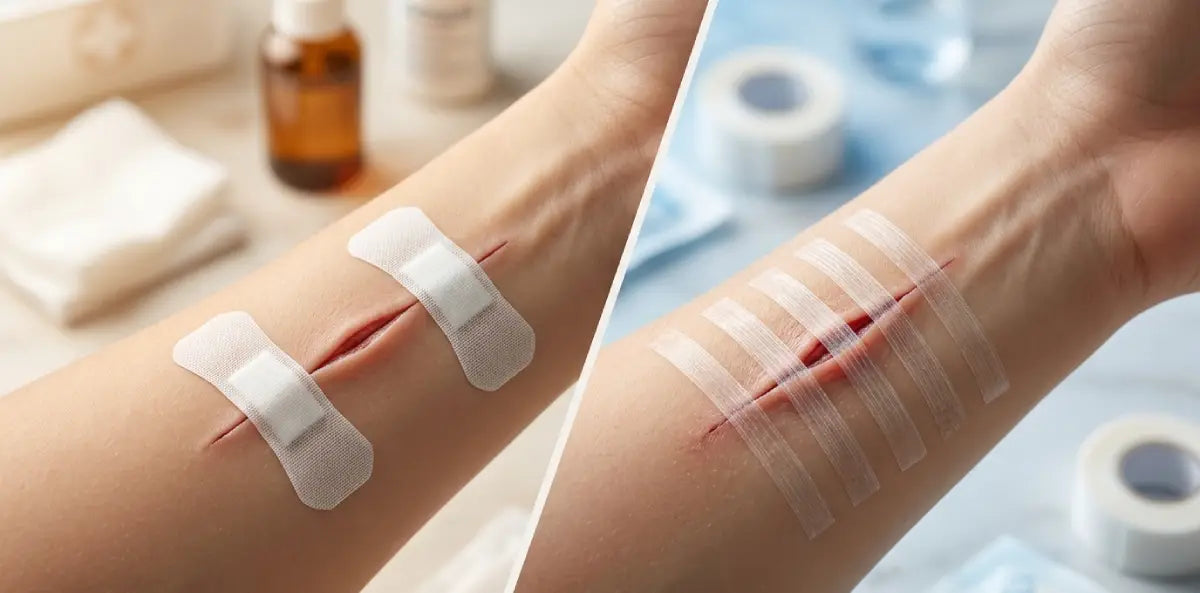
A butterfly bandage is an adhesive bandage with a narrow center and wider sticky ends. The narrow middle section sits over the cut, while the wider ends stick to the skin on each side. This shape helps pull the skin edges together without placing a full bandage pad over the entire wound. Butterfly bandages are common in home first-aid kits, medicine cabinets, school nurse supplies, workplace kits, and small travel kits.
Butterfly bandages are usually best for small, shallow, clean-edge cuts where the skin edges can meet naturally. For example, a short kitchen cut, a small tool nick, or a minor surface cut on a low-movement area may be the kind of wound where a butterfly bandage can help. The key is that the wound should already be cleaned, bleeding should be controlled, and the skin edges should not need force to stay together.
They are not ideal for every cut. If the wound is jagged, deep, wide, dirty, painful, still bleeding, or located across a joint, a butterfly bandage may not hold well. Worse, it may give someone a false sense of safety when the wound actually needs professional care.
Steri-Strips
Steri-Strips are thin adhesive skin closure strips used to support small cuts, minor lacerations, and some surgical incisions. They are often straight strips rather than butterfly-shaped bandages. In many healthcare settings, they may be used after stitches are removed, over minor surgical wounds, or on low-tension skin areas where the edges need light support.
A major advantage of Steri-Strips is their simple, low-profile design. They can be placed across the wound in a row, with small gaps between strips, to help keep the skin edges aligned. Many Steri-Strip-style products are also made with breathable material, which helps reduce trapped moisture around the wound. Product quality can vary, so the actual strength, adhesive type, water resistance, and comfort depend on the specific strip.
For home and emergency readiness, Steri-Strips or similar wound closure strips are useful because they take very little space in a kit. They can fit inside a compact first-aid kit, vehicle trauma kit, hiking pouch, range bag, or IFAK. Still, they should be stored with the basics: gloves, gauze, antiseptic wipes, sterile dressings, and medical tape. Closure strips alone are not a complete wound care plan.
Why People Confuse These Terms
People often use “butterfly bandage,” “butterfly stitch,” and “Steri-Strip” as if they mean the same thing. This happens because all three terms are connected to closing small wounds without needle-and-thread sutures. In casual first-aid conversations, someone may say “butterfly stitches” when they really mean any adhesive strip used to pull a cut closed.
The difference matters because shape and use can affect how the strip performs. A butterfly bandage uses its wide ends to pull from each side of the cut. A Steri-Strip-style closure is usually a straight strip placed across the wound. In some cases, both can support a minor cut. In other cases, one may fit better based on the wound’s shape, location, and tension.
Key Differences at a Glance
The easiest way to understand the difference is to compare how each one is built and how it is normally used. A butterfly bandage is more shape-based. It is designed with a narrow center and wider adhesive ends. A Steri-Strip is more strip-based. It is usually a straight adhesive closure placed across the wound. Both are meant for minor wound support, but Steri-Strips are more commonly linked with clinical use, surgical incision support, and straight adhesive skin closure.
|
Feature |
Butterfly Bandage |
Steri-Strip |
|
Design |
Narrow center with wide sticky ends |
Thin, straight adhesive strip |
|
Main purpose |
Pulls small wound edges together |
Supports wound edges across the cut |
|
Common use |
Small, shallow home first-aid cuts |
Minor cuts, lacerations, and surgical incisions |
|
Best wound type |
Short, clean-edge cut |
Clean, straight, low-tension cut or incision |
|
Adhesive style |
Wing-end adhesive design |
Porous or breathable adhesive strip, depending on product |
|
Common location |
First-aid kits and medicine cabinets |
Clinics, hospitals, first-aid kits, wound care kits |
|
Application style |
One bandage centered over the cut |
One or more strips placed across the wound |
|
Strength |
Basic support for small cuts |
May offer stronger support, depending on type |
|
Not for |
Deep, dirty, infected, or bleeding wounds |
Deep, dirty, infected, or bleeding wounds |
This comparison also helps explain why both products can belong in a prepared first-aid setup. A butterfly bandage may be enough for a very small household cut. Steri-Strips or similar wound closure strips may offer better placement flexibility for certain straight cuts or minor incision support. At Flaresyn, the emergency kit, wound closure strips should be part of a larger system that also helps with cleaning, dressing, protection, and bleeding control.
When to Use Butterfly Bandages or Steri-Strips
The best choice depends less on the product name and more on the wound itself. Before using either option, look at the wound carefully. Is it shallow or deep? Are the edges clean or ragged? Has bleeding stopped? Is there dirt or debris inside? Is it on a body part that bends or moves a lot? These questions matter more than the label on the strip. A good rule is simple: adhesive wound closure strips are for minor, clean, shallow wounds where the skin edges can come together easily. If you have to force the wound closed, if the cut keeps opening, or if bleeding is still active, the wound may need more than a bandage strip.
Use Butterfly Bandages For
Butterfly bandages are useful for simple cuts where the edges need gentle help staying together. They are often easy to apply and easy to store, which is why many people keep them in first-aid kits. They work best when the skin around the wound is clean and dry, the wound is short, and there is no heavy tension pulling the cut open.
Use a butterfly bandage for:
- Small, shallow cuts
- Clean-edge wounds
- Minor cuts where bleeding has stopped
- Low-tension areas of skin
- Simple first-aid kit use
- Short-term closure support before medical care, if needed
For example, if someone gets a small, straight cut while doing basic work around the house, cleaning the wound and using a butterfly bandage may help hold the edges together. But if that same cut is deep, dirty, or on a knuckle that bends all day, the bandage may not stay secure or may not be enough.
Use Steri-Strips For
Steri-Strips are a better fit when a thin, straight closure strip is needed across a clean minor wound. They are also commonly used for incision support after certain medical procedures or after stitches are removed, when a healthcare provider recommends extra skin support. Their slim profile makes them useful when several strips need to be placed across a wound with small spaces between them.
Use Steri-Strips for:
- Small clean cuts
- Minor lacerations
- Surgical incision support
- Post-suture support when advised
- Wounds where straight adhesive closure strips fit better
- Low-movement areas where strips can stay in place
Steri-Strips are especially useful when the wound edges line up well and the goal is to support the skin without bulky coverage. Still, they should not be used to close a wound that has not been cleaned, a wound that is still bleeding heavily, or a wound that looks infected.
Best Rule of Thumb
If the cut is small, clean, shallow, and no longer bleeding, either a butterfly bandage or Steri-Strip may help support the wound edges. Choose the one that fits the wound shape better. A butterfly bandage may work well for a short cut that needs a simple pull from both sides. A Steri-Strip may work better for a straight cut or minor incision where several thin strips can provide even support. If the cut is deep, wide, jagged, dirty, painful, contaminated, located on the face or across a joint, or still bleeding after pressure, do not rely on either product. Clean and cover the wound if safe to do so, control bleeding, and get medical help.
A good wound care setup should include adhesive closure strips, sterile gauze, gloves, antiseptic wipes, sterile dressings, and the right trauma supplies for the setting. A small medicine cabinet may cover minor cuts at home, but a vehicle kit, range bag, hiking pack, or tactical IFAK should be built for more than small scrapes.
When Not to Use Either One
Butterfly bandages and Steri-Strips can be helpful for minor cuts, but they are not made for every wound. The biggest mistake is trying to close a wound at home when it should be checked by a healthcare provider. If a wound is too deep, too dirty, still bleeding, or showing signs of infection, closing it with adhesive strips can trap bacteria inside and delay the care the person needs. A closure strip should support healing. It should not hide a serious injury.
Do not use butterfly bandages or Steri-Strips as the main solution if:
- The wound is deep or gaping
- Bleeding does not stop after direct pressure
- The wound is jagged, torn, or ragged
- Dirt, glass, metal, gravel, soil, or debris is stuck inside
- The cut came from an animal bite or human bite
- You can see fat, muscle, tendon, or bone
- The cut is on the face, near the eye, on the hand, or across a joint
- The wound is swollen, warm, red, painful, or draining pus
- There is a foul smell coming from the wound
- The person has fever, red streaks, or worsening pain
- The wound is deep or dirty and the person may need a tetanus shot
- The injured person has diabetes, poor circulation, or a weakened immune system
How to Choose the Right Option Based on the Wound
Choosing between a butterfly bandage and a Steri-Strip is easier when you judge the wound first. The strip is only the tool. The wound decides what tool makes sense. Look at depth, shape, bleeding, location, movement, and cleanliness. If the wound passes the basic safety check, then you can decide which closure style fits better. A butterfly bandage may be better for a short, small cut where one shaped strip can pull the skin edges inward. A Steri-Strip may be better for a straight cut where several thin strips can support the wound evenly. In both cases, the wound should be clean, shallow, and low tension.

By Wound Depth
Depth is one of the most important factors. A shallow surface cut may be safe to support with adhesive wound closure strips if bleeding has stopped and the edges meet naturally. A deep cut is different. If the wound goes below the top layer of skin, exposes fat or deeper tissue, or looks like it needs more than surface support, it should be checked by a healthcare provider. Depth also affects infection risk and scarring. A strip may hold the top layer of skin together, but it cannot repair deeper tissue. That is why a deep cut can look “closed” from the outside and still heal poorly underneath. If you are unsure how deep the wound is, treat that uncertainty as a reason to get professional care.
By Wound Shape
Clean, straight cuts are easier to close with adhesive strips. The edges line up more evenly, and the strip can hold them together with less tension. Ragged, torn, or jagged wounds are harder to manage because the skin edges may not match. These wounds can leave gaps, trap debris, and heal unevenly if they are closed without proper assessment. For a very small straight cut, either a butterfly bandage or Steri-Strip may work. For a longer straight cut, multiple Steri-Strips may provide more even support. For irregular wounds, adhesive strips may not sit flat or may pull the skin unevenly. That is a sign the wound needs more careful attention.
By Wound Location
Location can make a minor cut harder to manage. Areas that bend, rub, sweat, or move often can cause strips to loosen early. Cuts on knuckles, finger joints, elbows, knees, feet, and palms are harder to keep closed because the skin is constantly moving. A strip that works well on the forearm may fail quickly on a joint. Facial cuts also need extra care. Even a small facial cut may need medical attention because scarring matters more in visible areas. Cuts near the eye, mouth, or nose should be handled carefully. If a facial wound is deep, wide, jagged, or caused by impact, it is safer to get it checked.
By Bleeding Level
Bleeding should be controlled before using any adhesive closure. If blood keeps flowing, the strip will not stick well, and the wound may need more care. Minor cuts usually stop bleeding after steady pressure. If bleeding continues, spurts, or soaks through gauze, closure strips should not be the focus. For a prepared kit, this is a key lesson. Wound closure strips are useful, but they do not replace bleeding-control supplies. A practical first-aid kit should include sterile gauze, pressure dressings, gloves, and secure dressings before you worry about closing a small cut neatly.
By Environment
The setting of the injury matters. A minor cut at home after washing dishes is different from a cut on a trail, at a jobsite, at the range, or during roadside work. Outdoor and field wounds may involve dirt, sweat, debris, and delayed access to care. That means cleaning, protection, and monitoring become more important. Wound closure strips should sit inside a complete emergency setup, not loose at the bottom of a bag. A good kit keeps supplies clean, organized, and easy to reach. In a stressful moment, the best product is the one you can find fast and use correctly.
How to Apply Wound Closure Strips Safely
Applying butterfly bandages or Steri-Strips is simple, but the steps matter. Poor application can cause strips to peel off, pull the wound unevenly, irritate the skin, or allow the cut to reopen. The goal is to clean the wound, bring the skin edges close without force, and protect the area while healing begins. The steps below apply to both butterfly bandages and Steri-Strips. The placement changes slightly depending on the product shape, but the safety process stays the same.
Step 1: Wash Hands or Wear Gloves
Before touching the wound, wash your hands well or put on medical gloves. This lowers the chance of bringing bacteria into the cut. In a home setting, soap and water may be enough for your hands. In a vehicle, workplace, outdoor, or tactical kit, disposable medical gloves are a smart addition. Gloves are especially useful if you are helping someone else. You may not know their medical history, and they may be bleeding. A prepared first-aid kit should always include gloves because personal safety and wound safety both matter.
Step 2: Control Bleeding
Apply steady pressure with sterile gauze or a clean cloth until bleeding slows or stops. Do not rush this step. Adhesive strips will not stick well to wet, bloody skin. If the cut keeps bleeding, continue pressure and consider medical help rather than trying to force the wound closed. If bleeding is heavy, treat it as a bleeding-control problem first. Use appropriate emergency supplies and seek urgent care. Butterfly bandages and Steri-Strips are for closure support, not serious bleeding control.
Step 3: Clean the Wound
Clean the wound before closing it. Rinse away visible dirt and debris with clean running water if available. The skin around the wound should also be cleaned so the adhesive has a clean surface. Do not close a wound that still has dirt, glass, soil, or other material inside. Some people use strong chemicals on wounds because they think stronger means cleaner. In reality, harsh cleaning can irritate tissue. Follow product directions and medical guidance. If the wound cannot be cleaned properly, cover it with a sterile dressing and get medical care.
Step 4: Dry the Surrounding Skin
Adhesive strips need dry skin. If the surrounding skin is wet, oily, sweaty, or covered with ointment, the strip may peel off early. Gently pat the area dry with clean gauze. Do not scrub the wound. This step is especially important in outdoor, athletic, or field settings. Sweat, rain, dirt, and movement can all reduce adhesive performance. If you expect the area to rub against clothing or gear, you may also need a protective dressing over the closure strips.
Step 5: Bring the Skin Edges Together
Gently bring the wound edges close together. The edges should meet naturally without strong pulling. If the skin does not line up, if the wound keeps opening, or if closing it causes sharp pain, stop and get medical care. Good wound edge alignment can support cleaner healing. Poor alignment can increase scarring and may cause the wound to reopen. This is one reason deeper or more visible cuts should be checked by a healthcare provider.
Step 6: Apply the Strip Across the Cut
Place the strip across the wound, not along the wound. For a butterfly bandage, the narrow center sits over the cut while the wider adhesive ends secure the skin on both sides. For Steri-Strips, place the first strip across the center of the wound, then add more strips as needed with small gaps between them. Do not pull the strip so tightly that the skin bunches, folds, or turns pale. The goal is gentle support, not strong compression. If the strip is too tight, it can irritate the skin or affect blood flow near the area.
Step 7: Protect the Area
After the closure strip is in place, decide if the wound needs a protective dressing. If the area may rub against clothing, gloves, shoes, work gear, or outdoor equipment, cover it with a sterile dressing. This helps protect the strip from dirt, friction, and moisture. A complete wound care setup should include both closure and protection. Closure strips help approximate the skin edges. Dressings help shield the wound. Gauze helps manage fluid. Tape helps secure materials. These items work together, which is why a complete first-aid kit is better than a few loose bandages.
How Long They Stay On and How to Remove Them
Butterfly bandages and Steri-Strips often stay in place until they loosen naturally, but timing can vary. The wound location, moisture exposure, skin type, movement, adhesive strength, and product instructions all matter. A strip on a dry forearm may stay longer than a strip on a finger joint or sweaty area. The key is to avoid removing strips too early. If the wound edges still need support, pulling the strips off can reopen the cut. At the same time, strips should not be ignored if the wound becomes painful, infected, wet, dirty, or irritated.
How Long They Usually Stay On
Many adhesive wound closure strips are left alone until they begin to peel away on their own. Some may stay on for several days, depending on the wound and product. If a healthcare provider applied the strips, follow their instructions first. Do not judge healing only by the strip. Look at the wound. Is it closed? Is pain improving? Is redness spreading? Is there drainage? Is the skin irritated? A wound that looks worse should be checked even if the strip is still attached.
Safe Removal Tips
Remove closure strips gently. Wash your hands first. If the strip is already loose, slowly lift the edge while supporting the skin with your other hand. Pulling too fast can tear fragile healing skin or reopen the cut.
Use these safe removal tips:
- Wash your hands before touching the area
- Do not rip strips off quickly
- Loosen the edges gently
- Pull slowly while supporting the skin
- Stop if the wound starts to open
- Do not scratch or scrub the healing area
- Cover the area with a clean dressing if it needs protection
If the strip is firmly stuck and the wound is healing well, it may be better to let it loosen naturally. If you are unsure, ask a healthcare provider.
If They Fall Off Early
If butterfly bandages or Steri-Strips fall off early, first check the wound. If the skin edges are still together, the area is clean, and there are no infection signs, protect it with a clean dressing. Avoid rubbing or stretching the area. If the wound opens, starts bleeding, drains fluid, becomes painful, or looks infected, get medical care. Do not keep adding strips over a wound that is failing to stay closed. That is a sign the wound may need a different level of care.
Common Mistakes to Avoid
Most problems with butterfly bandages and Steri-Strips come from using them on the wrong wound or applying them too quickly. A person sees a cut, wants it closed, and reaches for a strip before checking the basics. That can lead to poor adhesion, trapped contamination, wound reopening, or delayed medical care.
Avoid these common mistakes:
- Closing a wound before cleaning it
- Using strips on deep or gaping wounds
- Applying strips over wet, oily, or bloody skin
- Pulling the wound edges too tightly
- Ignoring dirt, glass, soil, or debris inside the cut
- Using closure strips on bite wounds without medical advice
- Removing strips too early
- Picking at loose strip edges
- Ignoring infection signs
- Forgetting the tetanus risk after deep or dirty wounds
- Treating serious trauma like a minor household cut
Mistake: Closing a Dirty Wound
Closing a dirty wound can trap bacteria and debris. This can raise the risk of infection. If the wound cannot be cleaned properly, cover it with a sterile dressing and get medical care. This is especially important for outdoor, roadside, jobsite, and range-related injuries. Dirt and debris change the risk level. A wound that looks small may still need care if it is contaminated.
Mistake: Using Strips Instead of Bleeding Control
Closure strips are not bleeding-control tools. If a wound is actively bleeding, pressure and gauze come first. If bleeding is heavy or does not stop, seek urgent care. This is why a complete kit matters. A good emergency setup should include gauze and dressings, not just closure strips.
Mistake: Ignoring Movement and Tension
Cuts across joints or high-movement areas are harder to keep closed. Even if a strip sticks at first, movement may pull the wound open later. In these cases, protection, reduced movement, or medical care may be needed. A cut on a finger joint, palm, knee, or elbow should be watched closely. If the strip keeps lifting or the wound keeps reopening, it is not the right solution.
Final Recommendation: Which One Should You Use?
For a small, clean, shallow cut, either a butterfly bandage or Steri-Strip may help hold the skin edges together. A butterfly bandage is usually simple and easy for small first-aid use. A Steri-Strip is usually a thin adhesive skin closure strip that can support clean minor cuts, minor lacerations, and some incision care situations. The better choice depends on the wound. Use a butterfly bandage when a one-shaped strip can gently pull a short cut together. Use Steri-Strips when straight strips fit the wound better or when multiple strips are needed to support a clean, low-tension cut. Use neither as the main solution if the wound is deep, dirty, gaping, infected, or still bleeding.
The smartest answer is preparation. Keep wound closure strips in your kit, but do not keep them alone. A reliable first-aid setup should include gloves, gauze, sterile dressings, antiseptic wipes, medical tape, and bleeding-control supplies. For home, vehicle, outdoor, range, workplace, and tactical readiness, Flaresyn’s wound closure kits and first-aid supplies can help you keep the right items organized before an injury happens.
FAQs About Butterfly Bandage vs Steri Strip
Are butterfly bandages and Steri-Strips the same thing?
They are similar, but they are not always the same. Butterfly bandages usually have a narrow center with wider sticky ends. Steri-Strips are usually thin, straight adhesive skin closure strips. Both can help support small wound edges, but their shape and use can differ.
Which is better: butterfly bandage or Steri-Strip?
It depends on the wound. A butterfly bandage may work well for a small, short, clean cut. A Steri-Strip may work better for a straight cut or minor incision that needs thin strip support. Neither is better for every situation.
Can I use butterfly stitches instead of stitches?
Only for minor, shallow cuts where the skin edges come together easily. Deep, wide, dirty, jagged, or heavily bleeding wounds may need stitches or another medical closure method.
How long should butterfly bandages stay on?
They usually stay on until they loosen naturally or the wound no longer needs support. Timing depends on the wound, product, skin type, location, and moisture exposure.
How long do Steri-Strips stay on?
Steri-Strips often stay on until they begin to peel away on their own. If a healthcare provider applied them, follow their instructions. Do not pull them off early if the wound still needs support.