
Beyond the Band-Aid: Why Your Family Vacation Needs a Professional Trauma Plan
The Protected Journey: Advanced Family Trauma Planning
There is an undeniable luxury in modern travel. We pack our SUVs, set our navigation systems to remote mountain cabins, coastal hideaways, or secluded national park campgrounds, chasing the peaceful distance that modern life denies us. We invest in top-tier all-wheel-drive vehicles, premium roof racks, and high-end outdoor gear to ensure our family’s comfort and isolation. Yet, within this pursuit of serene distance lies a dangerous psychological paradox: the further we distance ourselves from the chaos of the city, the further we distance ourselves from the emergency medical infrastructure we take for granted every day. We wrap ourselves in an illusion of safety, assuming that a modern smartphone and a stable cellular signal mean a first responder is always just a few minutes away.
This assumption is a fatal gamble. In the backcountries, rural highways, and coastal transits that define the classic family road trip, the "911 Myth" quickly unravels. If a member of your family suffers a critical injury—a deep laceration from a slipping camp ax, a severe puncture from a jagged branch, or a major bleed caused by a highway collision—emergency medical services (EMS) will not arrive in seven minutes. In remote areas, ambulance dispatch times often extend past 30 to 45 minutes, assuming you even have the cellular service required to make the call. When an arterial breach occurs, a human being can bleed to death in less than three minutes. In these vast geographical gaps, you are not waiting for a first responder; you are the first responder.
True peace of mind cannot be purchased through premium travel insurance or reactive hope. It requires reframing a professional-grade trauma kit not as an esoteric piece of military surplus, but as a fundamental pillar of your family’s safety infrastructure. Just as you wouldn’t drive without a seatbelt or cross a lake without a life vest, you should not venture beyond the city grid without the mechanical and chemical tools required to stop a catastrophic bleed. At FlareSyn, we believe that protecting your loved ones demands more than passive reliance on a distant rescue system; it requires active preparedness. This guide will show you how to look past the superficial safety of store-bought kits and equip your family for the realities of the road.


Beyond the Band-Aid: Decoding the Failure of Retail First Aid Kits
If you open the trunk of most family vehicles or look inside a standard camping container, you will likely find a familiar object: a bright red or blue plastic box labeled "First Aid Kit," typically purchased for twenty dollars at a local pharmacy or big-box retailer. For years, families have carried these kits as a compliance box to tick, believing that possessing one means they are prepared for a medical crisis. This is a profound and dangerous misunderstanding. Retail first aid kits are designed for minor clinical conveniences, not for major trauma management. They are built for a world where help is already in the next room, completely failing when deployed in the wilderness or on a remote highway.
The Ointment and Adhesive Illusion
To understand why retail kits fail, one must examine their contents through the lens of kinetic energy. A standard store-bought kit is packed with hundreds of items, a number used by manufacturers to create an illusion of value. However, a closer inspection reveals that 90% of these components consist of varying sizes of plastic adhesive bandages, antiseptic wipes, safety pins, burn creams, and miniature plastic tweezers
These items are perfectly suited for superficial lifestyle inconveniences—a child’s scraped knee at a manicured playground, a minor splinter from a backyard deck, or a small kitchen burn. They provide comfort, not survival. They possess zero utility when a high-energy accident occurs. A standard plastic bandage cannot seal a pressurized arterial bleed, and a small roll of non-sterile concession gauze cannot pack a deep puncture wound.
The Critical Equipment Gap in Real-World Trauma
When real trauma occurs during a family excursion, it involves high forces and sharp materials. Consider a camping trip where a utility knife slips into a femoral artery, a severe vehicle impact that breaks a window into a shower of high-velocity glass shards, or a heavy fall on a jagged ridge that causes an open fracture with severe muscle shearing.
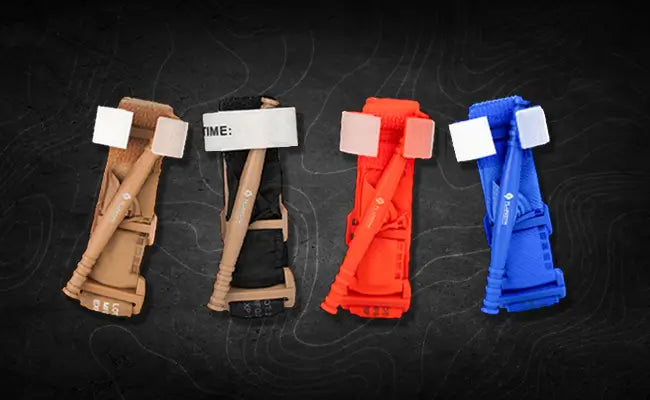
In these scenarios, the patient is facing massive, fast-moving blood loss. A retail first aid kit contains no mechanism to stop this. It lacks a windlass tourniquet to occlude arterial flow in an extremity. It lacks hemostatic agents to chemically accelerate clotting in junctional wounds. It lacks the advanced hydrogel chest seals required to keep a punctured lung inflated. Relying on a commercial retail kit during an arterial bleed is the equivalent of bringing a plastic umbrella to a category-five hurricane.
Retail First Aid Kits vs. FlareSyn Professional Trauma Systems
| Feature / Capability | Standard Retail First Aid Kit | FlareSyn Professional Trauma System |
| Primary Design Intent | Minor comfort care (scrapes, minor burns, splinters). | High-energy trauma stabilization (hemorrhage, puncture, shock). |
| Hemorrhage Control | None. Includes only basic, non-elastic cotton gauze. | Mechanical & Chemical: High-torque windlass tourniquets and medical-grade Chitosan gauze. |
| Respiratory Support | None. Completely absent of chest injury gear. | Advanced Occlusion: Multi-vent hydrogel chest seals to manage sucking chest wounds. |
| Environmental Protection | Basic foil sheets or no environmental barrier. | Metabolic Armor: Heavy-gauge, high-reflection thermal mylar blankets to fight shock. |
| Component Philosophy | High quantity of low-utility items (e.g., 200 plastic bandages). | High utility of critical medical components engineered for extreme stress. |
The Three Most Common High-Stress Family Trauma Scenarios
To appreciate the necessity of professional-grade intervention tools, we must look past abstract concepts and analyze the precise environments where families encounter severe kinetic risk. These are not battlefield scenarios; they are ordinary moments within an active, modern lifestyle that can pivot into a medical emergency in a fraction of a second. When these crises occur in isolated settings, your preparedness level directly correlates with your family's survival rate.
Scenario 1: The Remote Highway Collision
Consider a cross-country family road trip, navigating a two-lane rural highway late at night. A sudden collision with wildlife or an oncoming vehicle forces your car off the shoulder. The vehicle’s safety cages and airbags deploy, saving lives inside the cabin, but the force of the impact shatters the side glass into high-velocity projectiles.
As you assess your family, you realize your passenger has suffered a deep, jagged laceration to their upper arm from a structural shard of glass. Blood is rapidly soaking through their clothing and pooling on the seat cushion. In this environment, you are miles from the nearest town. The local volunteer EMS dispatch is at least twenty minutes away. Without an immediate mechanical means to shut down that brachial artery bleed, your passenger will lose consciousness long before the flashing lights appear on the horizon.
Scenario 2: The Backcountry Backfire
Imagine a pristine family camping excursion in a secluded national forest. While splitting firewood for the evening camp, a high-quality camping ax slips off a wet log, striking the user’s lower leg. The heavy, sharp blade shears through heavy canvas pants and breaches the deep tissue of the inner thigh—the site of the femoral artery.
The injury is instantaneous, catastrophic, and deeply terrifying. Because you hiked three miles from the trailhead to find this perfect, isolated campsite, there is zero vehicle access. Cell phone reception is intermittent at best. You cannot rely on a helicopter evacuation to arrive within the golden hour of trauma care. The clock is ticking at an aggressive rate.
Scenario 3: Home and Workshop Hazards
Trauma does not require a passport or a wilderness permit; it frequently occurs within our own properties. High-torque power tools, modern woodworking equipment, shattered lawnmower blades striking hidden rocks at thousands of rotations per minute, or severe falls from ladders during routine home maintenance can cause complex, devastating injuries.
A heavy laceration from a circular saw or an open structural fracture from a fall can happen in a backyard workshop while your family is inside the house. Even within suburbia, a severe storm can down trees and trap a family member before municipal services can respond. The immediate threat profile remains identical: uncontrollable bleeding and rapid systemic shock.
The Psychological Shift: The Duty of Care as a Parent and Partner
To move from a passive consumer to an active protector requires a fundamental psychological shift. In the vocabulary of modern risk management, we often talk about outsourcing our safety—relying on insurance policies, vehicle safety ratings, and municipal emergency services. But when a severe accident occurs in a remote setting, outsourcing ceases to be an option. At that precise moment, the conceptual barrier between "safety" and "catastrophe" is reduced to a single factor: your personal capability. For a parent, partner, or homeowner, being unprepared isn't just a logistical oversight; it is an emotional burden that can haunt a family forever.
The True Cost of Unpreparedness: Facing the Void
Imagine the profound psychological weight of standing over an injured loved one—a spouse or a child—knowing exactly what needs to be done biologically, but lacking the physical tools to execute the solution. Watching a severe bleed progress while holding nothing but a standard retail box of small adhesive strips and antiseptic wipes is a form of trauma itself.
The true cost of unpreparedness is not financial; it is the agonizing feeling of helplessness. When a child or partner looks to you for decisive action, their survival should not be compromised by an empty safety net. True guardianship demands that you possess the tools to match your instinct to protect.
Active Protection vs. Passive Waiting
Carrying professional-grade medical gear alters your family’s entire relationship with adventure. It shifts your baseline posture from a vulnerable, reactive state of hope to a resilient, active state of confidence.
When you know your vehicle or your backpacking setup contains an advanced medical infrastructure, you don't fear the distance; you respect and manage it. You are no longer passively waiting for a distant savior to arrive on the scene. Instead, you have chosen to extend your household's protective canopy into the wilderness, ensuring that your standard of care remains uncompromising, no matter your location on the map.
Building the Ultimate Family Safety Infrastructure
Investing in a premium trauma system is the foundational step, but its ultimate utility depends on availability and accessibility. A world-class medical system locked away in a deep home basement or buried underneath hundreds of pounds of luggage in a packed roof box is functionally non-existent when an accident occurs. To build a resilient safety infrastructure, your gear placement must be strategic, and the equipment design must be intuitive enough to bridge the gap between professional medicine and civilian panic.
Placement Strategies: Seconds vs. Minutes
In the geography of an emergency, distance is measured in seconds. Your equipment placement should follow a layered logic based on immediate access:
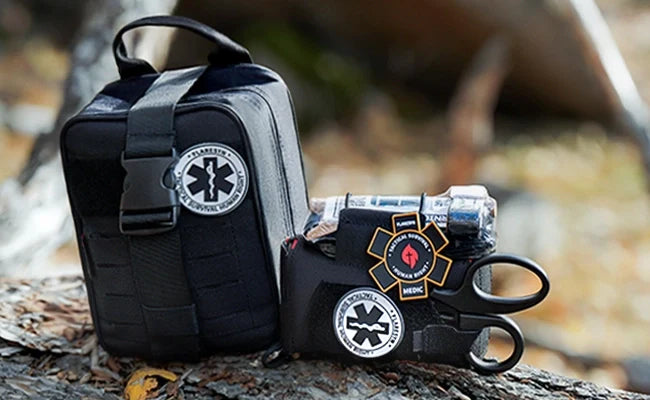
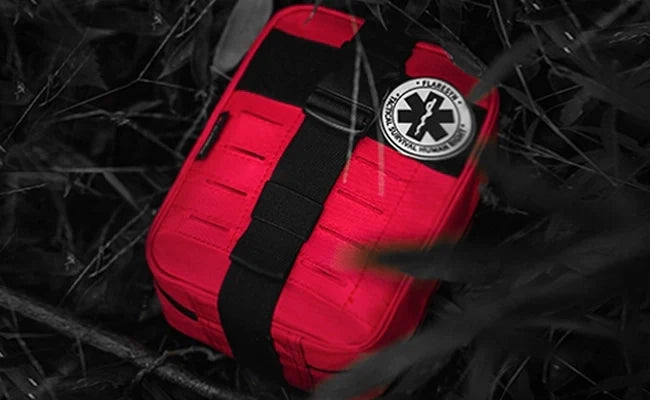
The In-Cabin Layer: Your FlareSyn Vehicle Response Kit (VRK) should be within arm's reach of the driver or passenger seat. Ideal locations include the glove compartment, front seatback pockets, or securely mounted beneath the seat rail. If a serious collision compromises the vehicle's frame, jamming the trunk lid shut, you must have immediate access to your tourniquets inside the cabin.
The Basecamp/Trunk Layer: For extended outdoor trips, your high-capacity Comprehensive Family System (CFS) serves as your logistical anchor. This should reside in an easily accessible, dedicated slot in your trunk or at the main shelter of your campsite. Every family member must know its exact location: "Behind the left rear wheel well" or "In the red storage bin at the camp center."
The "No-Experience-Required" Fallback: Overcoming Panic
The primary barrier preventing civilians from deploying professional gear is the fear of making a mistake. In a high-stress family emergency, adrenaline can cause your hands to shake and your mind to blank. FlareSyn addresses this reality through a design philosophy we call Cognitive Insurance.
Our systems feature high-contrast, universally recognized visual cues and sequential packaging that guides the user step-by-step. The interior modules are organized alphabetically and chronologically to match the MARCH protocol automatically. If you are incapacitated, an anxious partner or an older teenage child can open the kit and instantly understand how to deploy the tools based on clean typography, clear diagrams, and color-coded pulls. By removing the need for complex decision-making, FlareSyn transforms an intimidating medical task into a straightforward, manageable process.
True peace of mind is not built on the fragile hope that nothing will ever go wrong. Rather, it is anchored in the quiet, resilient confidence that you have the tools, the organization, and the system to manage a crisis if it arrives. Choosing to venture into the backcountry, embark on a cross-country highway trip, or build a dedicated home workshop is an embrace of an active, fulfilling lifestyle. Protecting that lifestyle requires an equal commitment to safety infrastructure.
Do not allow an ordinary family vacation to be compromised by an inadequate, low-utility retail first aid kit. Move past the illusion of safety and step into genuine preparedness. Invest in professional-grade trauma capability, establish your family's safety protocol, and secure the baseline protection your loved ones deserve.
Protect what matters most, wherever the road leads. Upgrade your family’s safety infrastructure with FlareSyn Systems today.
Q: Can a teenager or an elderly relative really use a windlass tourniquet effectively?
A: Yes. While professional training is always ideal, modern high-torque windlass tourniquets—like those integrated into FlareSyn systems—rely on mechanical advantage rather than pure physical strength. Our systems utilize reinforced composite rods and high-friction tracking systems that multiply applied force, allowing an older child or an elderly family member to achieve arterial occlusion with minimal physical strain.
Q: How do FlareSyn kits hold up against extreme temperatures inside a vehicle trunk or glove box?
A: This is a critical engineering focus for vehicle-based medical gear. Standard retail kits use cheap adhesives and thin plastics that degrade, melt, or lose stickiness after a summer inside a hot car. FlareSyn medical components, including our Vented Chest Seals and Chitosan Gauze, are vacuum-sealed in heavy-duty, UV-protective, multi-layer foil packaging designed to withstand extreme thermal fluctuations (from sub-zero winter temperatures to 150°F vehicle interiors) without compromising shelf life or adhesive integrity.
Q: Do I need to replace the entire kit if I use one component during a minor camp mishap?
A: No. FlareSyn systems are built on a modular, sustainable architecture. If you open a specific compartment to use a pressure bandage or a package of hemostatic gauze, you do not need to buy a whole new kit. We offer individual replenishment modules and component refills through our online store, allowing you to easily maintain a fully stocked, 100% mission-ready infrastructure at all times.


Elias.H.Hwang
Elias H. Hwang is a tactical medicine expert and lead contributor at FlareSyn. He specializes in emergency trauma protocols and preparedness education, helping civilians and professionals alike master the tools and skills needed to save lives in critical moments.

Dejar un comentario
Este sitio está protegido por hCaptcha y se aplican la Política de privacidad de hCaptcha y los Términos del servicio.